Thursday, March 20, 2014

Trainer Friends

For my friends in the mid-west, I wanted to share a great dog training opportunity.  This session will be taught by an amazing dog trainer, and my former mentor, Inga From.  Inga is one of only a handful of people in the United States that teaches positive gun-dog training.  If you are looking to do some hunting with your dog, or have a dog that loves to fetch, I highly recommend you consider taking this seminar with Inga.  I was privileged to have attended former Gun-Dog Training weekends with Inga, and they are quite informative and fun.

Details and registration available at www.PositiveGunDogsMN.com


Field Sport for the Family Dog
Intro weekend

Positive Gun Dogs of Minnesota welcome
Inga From, CDBC, CPDT-KSA
As She Presents Her Two-day Beginner Positive Field Dog Seminar
May 3rdth & 4th, 2014
Stone Mountain Pet Lodge–Blaine, MN
About this seminar:
An urban field sport for the family dog is an opportunity to see what your sporting breed dog was bred to do or for any dog that loves to fetch!
Effective and efficient dog-friendly training methods for field dogs without the use of force fetch training or e-collars.
Seminar Overview:

Day One:
• Overview of positive field sport’s

• Positive training basics

• Assessment of foundation skills

• Introduction to scent work

• How to teach a retrieve with positive training

Day Two: (outdoors)


• Into the field

• Introduction to field training

• Individual time with instructor

• Level 1: K9 Field Sport Testing
Cost: Two-day working spot for one handler & one dog $235
Team Discount: Two-day working for two handlers & one dog $270
Two-day auditor/observer spot-no dog $180


Inga From, CDBC, CPDT-KSA  My Bio
Certified Dog Behavior Consultant
 (International Association of Animal Behavior Consultants)

Certified Professional Dog Trainer 
(Certification Council for Professional Dog Trainers)


Offers Positive Training for dog owners and their dogs.

Association of Pet Dog Trainer’s national award winner

Positive Training based on the LIMA (Least Invasive Minimally Aversive) principle.

Professional Member of the Association of Pet Dog Trainers.

Inga specializes in shelter/rescue dogs. She has worked in shelter settings for over 10 years. Five of those years were spent at a local humane society where she served as the expert for the shelter in behavior and training. 

Inga Offers:


Monday, March 3, 2014

Trainer Tips--Picking up Poop in the Dark

So I was hanging out with some neighbors and their dog the other night and we went out to the yard for a last dog potty break before bed.  Many times I see people bring flashlights or use their cell phone to find where the poop landed, but what happens when you have none of these things and are searching for it in the dark?

Well this month's Trainer Tip is helpful, yet extremely simple.  It's something I've been doing for years now.  Whenever my dog(s) stop circling and go for the Number 2, I point my foot in the direction of where it will land.  That way you don't have to stare and watch, which of course no one really wants to do, but you also won't lose it in the dark or bad weather and spend time having to search.  Like I said, simple, but very helpful.

So from now when you take your dog out at night to do his business, just remember to point your foot the direction of where the poop will land and you won't lose it in the dark.

Happy night walking everyone!

Saturday, March 1, 2014

Breed of the Month--King Shepherd


King Shepherd

Color:  Sable, bicolor (mostly black with red, cream, or tan), black saddle with red, gold, tan, silver, or cream markings, solid black, solid white.
Height:  Males:  27 inches/  Females:  25 inches
Weight:  Males:  100 lbs/  Females:  80 lbs
Life Span:  11-14 years

Breed Health Concerns:  May include hip dysplasia.

Coat:  Two varieties:  1) Coarsehaired:  has dense, straight outer coat with varying hair lengths, 
2) Longhaired:  has a longer coat but is not always straight.
Country of Origin:  United States

Visit the American King Shepherd Club (AKSC) for more information.

It is unknown just how many breeds went into making the King Shepherd, but among those credited most often include:  the German Shepherd Dog, Alaskan Malamute and the Great Pyrenees.  American breeders David Turkheimer and Shelley Watts-Cross are credited with the development of this breed.

Originally developed to get away from the many breed health problems of the German Shepherd Dog, the King Shepherd was developed to serve as both guardian and shepherd.  He is most defined by his massive head.  The King Shepherd is strong, rugged, and solid.  The breed was developed as a protector, but also as a working and family dog.  He is poised, self-confident, and alert.  He may be somewhat wary of strangers, as it is his instinct to protect his family.

Exercise:
The King Shepherd is most satisfied when he has work to do.  This breed needs plenty of daily walks and regular exercise to be happy.  If not properly exercised, the breed may become destructive.  Consider this breed a high energy breed.

Grooming:
Both coat types of the King Shepherd need regular brushing a few times each week.  His undercoat will shed and must be kept clean from dead hair.  The longhaired King Shepherd's coat will need a bit more attention as it is more likely to become caked with debris and tangled.

Training:
Socialization from an early age is extremely important for this large breed.  The King Shepherd is obedient and intelligent and training him can be a real joy.  It is very important to build a good relationship between owner and dog right away.  As with the German Shepherd Dog, the King Shepherd as a breed is very owner/ family orientated.


Tuesday, February 18, 2014

Certified Mentor Trainer for ABC


I am very excited to announce that I will now be mentor training with Animal Behavior College.  As a former student of ABC, I am very familiar with their curriculum and will be very excited to offer my insights into the next generation of dog trainers.


As a look back, I'm adding a picture of me when I was a student with my mentor trainer, Inga From.  Inga teaches both Basic Manners dog training classes and Positive Reinforcement Hunting Dog training.  If you are interested in positive gun-dog training, please visit her website.
Positive Gun Dogs of Minnesota.  It is very rare to find a trainer who teaches hunting dog classes using positive reinforcement dog training.

Athena & Inga From.

Also see SGDs previous post on Positive Gun-Dog Training.

Thursday, February 6, 2014

Breed of the Month--Afghan Hound


Afghan Hound


Color:  All colors.
Height:  Males:  26-29 inches/ Females:  24-27 inches
Weight:  Males:  60lbs/ Females:  50lbs
Life Span:  12-14 years

Breed Health Concerns:  Allergies, cataracts, chylothorax, bloat, hip dysplasia, and cancer.

Coat:  Fine, silky, and thick, with a top layer of long hair (may have lower jaw beard).
Country of Origin:  Afghanistan


Visit the American Kennel Club for breed standards and more information.


This beautiful sight hound comes from Afghanistan, India, and Pakistan.  The breed was created to be a guardian and protector to both livestock and humans alike.  The breed was developed to be an independent think, with a coat that withstand harsh environments, both cold and hot.  The Afghan Hound did not leave the region until the turn of the 20th century.  The breed is now prized all over the United States for his beauty and grace he shows in the competition ring.

Although the Afghan Hound has great beauty and grace, he is a goofball at heart.  The Afghan Hound is determined and athletic, and will follow his owner anywhere.  Because he is a dog that hunts by sight, care should be taken around smaller animals.  

Exercise:
Because the Afghan Hound was bred for hunting quick moving prey, this dog needs to get outside and get plenty of exercise often.   The Afghan Hound will thrive on some quality play time (in a secured area) along with several long walks a day.  

Grooming:
For a first-time Afghan Hound owner, a professional groomer is a must.  Because of their think coats, intensive grooming is required.  The coat of the Afghan can only be brushed after being washed so as not to damage the hair.  Extra care must be taken to ensure the dog's long ear hair stays out of food and water bowls.

Training:
Socialization at an early age is especially important to reduce the Afghan Hound's large prey drive.  Although very intelligent, the independent Afghan can be difficult to train.  For best training results, be sure to use positive-based training methods.  The Afghan Hound excels at many events including:  dog shows, agility, obedience, and lure coursing.


Wednesday, February 5, 2014

Trainer Tips--What do your dogs really want to do?

As a trainer, I am familiar with all kinds of dog questions.  One of my favorites is, "what does my dog want to do?"  As in, if my dog could do anything, what would it be?

Your dog wants to run and play, but also wants to be with you.  Dogs enjoy the experience of traveling with the pack.  The best form of exercise for your dog is a well-balanced pack hike.  Notice the way I worded that sentence.  There is a very large difference between a hike where your dog runs wild, and a well-balanced/ organized hike.  You want to be organized, but not overly-so.  Basically, a dog should earn everything from you as the owner, including the right to be let off leash while on a hike.  If you do not trust your dog or cannot control your dog, they have NOT earned the right to be off leash.  In that case, your dog should be secured to a long line (a 20-30 foot leash).  Do NOT use an extend-leash.  The extend-leash always has tension on the line, and encourages the dog to pull.  While on a hike and lone line, your dog should NOT be pulling you.  The purpose of using a long line is to teach a dog how to be off-leash but stay within a certain distance of you.  If you allow your dog to pull on a long line, this lesson will never be learned.

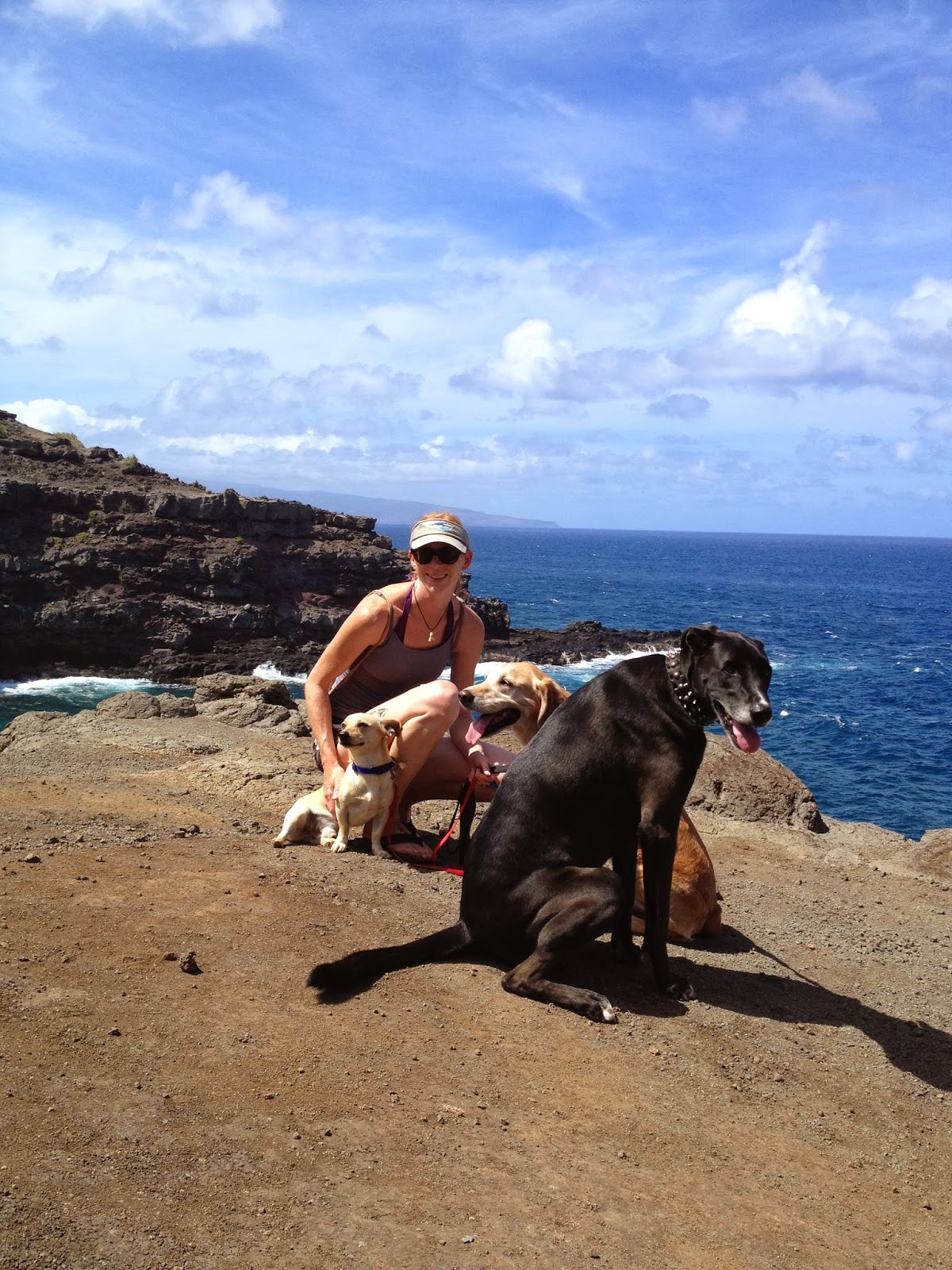
A great pack hike is also fun (and good exercise) for the humans.  You get to see and explore some of the amazing sites Maui has to offer that are right in your backyard.
One of the amazing views from the Village Trails in Kapalua.

Athena with Toby, Nekita, & Caravaggio at Kapalua Coastal Trails.


Important things to remember when going on a pack hike...

Make them wait and calm down.
Before the dogs even get out of your car, they should be made to sit and wait.  My dogs are required to do this EVERY TIME.  The reason for this (and it's important) is because whatever the mind-set your dog is in when he is let out of the car, that is what he will take into that environment.  So if you let your dog out while they are crazy and bouncing all over the car, they will take that crazy into the outside environment.  This is a very difficult mind to control or even be heard by at all.  But, if you take the extra few minutes to make your dog sit and wait to be released until they have calmed down, they will go into the new environment much more relaxed and not be as apt to run off or offer other poor behaviors.


Make sure the pack gets along.
Go with someone (dogs) that your dog already knows and gets along with, or someone you know you can trust.  My dogs are well trained and familiar with how many dogs behave, good or bad, and know how to properly react.  I often use my own dogs to help train others.  The pack hike is one of my favorite activities to bring new dogs into, especially if they have issues dealing with other dogs or running away from the owner.  Using the Such Good Dogs pack is great because my dogs (and other dogs I have trained in the past I also use) know how the hike works and are obedient.  They will run through the field or woods or whatever, but come back to me and check in often.  They are not allowed and have learned to never wander too far away.  I will usually use a long-line (20-30 foot leash) for dogs that are new to the pack hike or particular area.  This ensures that this dog will follow the rules, because he is secured with a leash.  This keeps the new dog from straying too far from the pack.  Dogs who are off-leash have earned the right to be so.  Remember...Safety First!  If you don't trust your dog, have them secured to a long line.  If you don't trust someone else's dog, don't hike with them.


Good Exercise.
There is a difference between just plain physical exercise and mental activity.  Both of these things are very important for your dog.  Many times people like to just let their dogs run around crazy in their backyard or at the dog park.  Yes, your dog is getting some physical exercise, which is important, but they are doing so in a chaotic, undisciplined way.  It is much more important for your dog to engage in mental activity than just plain physical exercise.  Your dog will actually be more tired, and more satisfied with more mental challenges.  Furthermore, a dog who is more mentally focused is less likely to ignore their owner, and get into bad situations with other dogs.  The best way to protect your dog is to TRAIN HIM!

Below are some of the many pictures I have from various pack hikes.  You will see my dogs many times, as they are always a part of this type of dog training.

I love this picture.
Notice that the two further back are on leash,
they had not yet earned the right to be off leash.

Hiking near West Maui Kennels.

Lipoa Point.

We came across these two dogs while hiking the gulch. 

Lipoa Point.

The Village Trails.

The pond at the top of the Village Trails.


Amazing Maui and my dog(s).
One of my favorite things about some of these hikes is posing with my pack for some amazing Maui pictures.  This is a great goal for you to have and work towards.  Then you can proudly display some amazing pictures of you and your pet and show all your friends on the mainland how much fun you have together.  Below are some of my favorite amazing pictures with dogs.

Nekita at Honolua Bay.

Irie, Caravaggio, & Nekita

Beck at sunset.  Honolua Bay.

Athena with Toby at Kapalua Coastal Trail.

Athena with Nekita & Caravaggio near Honolua Bay.
I have a lot of these pictures (me and my 2 dogs).
This is my new favorite.


Wednesday, January 8, 2014

Trainer Tips--Holiday surprise pups


As we move into a new year, I like to remind people about some things we forgot during the busy holidays.  Today I would like to focus on people who received puppies or dogs as a Christmas or Holiday gift.  We hope that all these pups were given to someone who wants them, but that unfortunately is not always the case.

For those of you who did receive a holiday puppy and love you new pet, I am extremely happy for you.  Please remember to start training your puppy right away on basic manners and socialization.

On the flip side, this time of year is one where many times the shelter receives extra puppies and dogs that were given to someone over the holidays that did not want them.  It is very sad to think of, but it does happen.

So if you happen to be someone who was hoping for a holiday puppy and did NOT get one, it is the perfect time for you to go visit the shelter.  Keep your eyes open.  The shelter gets in new dogs and puppies for adoption all the time.  Once you have made the decision to get a dog, that does not mean you have to get it THAT DAY.  Take the time to prepare yourself and your household.  Never rush into adopting a dog.  Choose a dog that is right for you because he matches your energy and life-style, not just because he's the cutes puppy there the day you go for a visit.  Your dog should have the same or a lower energy level than yourself and family.

As always, please be responsible owners.  Teach your dog discipline and respect.  Teach your dog how he should properly behave in society.  Raise a dog you can be proud of.  If you need help, there are many other blogs within this site that offer different kinds of advice and training.  Of course, you can always give me a call and I can help you personally.

Above all else, please...don't let you puppy become this…

Wednesday, January 1, 2014

Lahaina Dog Training Class Starts January 3rd

Lahaina Dog Training Class starting soon…

Fridays 4:30-5:30 p.m.
January 3rd -- February 7th

This is a beginner class for dogs and their owners.  Dogs of all ages are welcome to join, provided they are up-to-date on Parvo and Distemper shots.  This is a 6-week class, one hour per week.  Each week you will learn something new to practice with your dog.  Basic Manners Dog Training is taught using positive reinforcement methods, combined with energy balance.

Cost for the class:  $150 CASH
Basic Manners Class includes:

*Marker Words
*No Reward Marker
*Come when called
*Watch Me/ Look
*Loose Leash Walking 
*Impulse Control 
*Sit & Auto-sit
*Down  
*Stand  
*Stay
*Drop It
*Leave It


If you are interested in the class, please contact us with:  your name, phone number, email, and name, age, and breed of your dog.
808-463-4684
suchgooddogs@gmail.com

Start your new year off the right way with a new positive outlook on life, and dog life.  Plus, everyone makes friends in dog training class.
(Kahiko & Dora, above left)


Berkeley & Sophie.

Splash & Eku.

Liko, Beau, & Hiccup.

These ladies actually switched dogs 
and loved each other's pups up after class one day.


Friday, December 6, 2013

Basic Manners Classes Starting Soon


Basic Manners Dog Training Classes 
Starting in January 2014
Lahaina, Kihei, & Kahului

This is a beginner class for dogs and their owners.  Dogs of all ages are welcome to join, provided they are up-to-date on Parvo and Distemper shots.  This is a 6-week class, one hour per week.  Each week you will learn something new to practice with your dog.  Basic Manners Dog Training is taught using positive reinforcement methods, combined with energy balance.

Cost for the class:  $150 CASH
Basic Manners Class includes:

*Marker Words
*No Reward Marker
*Come when called
*Watch Me/ Look
*Loose Leash Walking 
*Impulse Control 
*Sit & Auto-sit
*Down  
*Stand  
*Stay
*Drop It
*Leave It


Please contact Athena @808-463-4684 or email suchgooddogs@gmail.com to register.
Classes will be available Thursday or Friday, morning and afternoon.


Please let us know your name, phone number, email address, what day/ time works best for you, your location, & name, breed, and age of dog.


Athena Angelic, is an Animal Behavior Certified Dog Trainer, has been certified in pet first aid and CPR through the American Red Cross, and is a full member of the Association of Pet Dog Trainers.  Such Good Dogs specializes in training companion dogs, or family dogs, using positive reinforcement methods, combined with energy balance.  Such Good Dogs offers many different types of training programs, in-home dog boarding, dog adventures, and dog bootcamp.


suchgooddogs@gmail.com
808-463-4684


Sunday, December 1, 2013

Breed of the Month--Irish Setter

Irish Setter

Color:  Rich chestnut red with no trace of black, may have white markings.
Height:  Males:  23-27 inches/  Females:  21.5-25 inches
Weight:  Males:  70-75 lbs/  Females:  60-65 lbs
Life Span:  11-15 years

Breed Health Concerns:  Arthritis, canine leukocyte adhesion deficiency (CLAD), bloat, hip dysplasia, epilepsy, hypothyroidism, patent ductus arteriosus (PDA), osteosarcoma, progressive retinal atrophy (PRA), and von Willebrand disease.

Coat:  Straight, flat, with feathering, moderate length.
Country of Origin:  Ireland

Visit the American Kennel Club for breed standards and more information.
Also see our previous post on Sporting Breeds.

The exact origins of the Irish Setter are not known, but the breed is believed to be developed from pointers, setters, and spaniels.  These dogs have a highly developed sense of smell and were bred to locate birds and hold their position instead of chasing.  The unique abilities of this breed made it highly sought after in the 18th century for hunting and tracking.  The magnificent color of the dog's coat gained it popularity in the show ring in the 19th century.  The Irish Red Setter Club was formed in 1882 in Ireland.  The Irish Setter was brought to the United States in the late 1800s and the breeds popularity again grew.  A few years later, an overwhelming demand for Irish Setter puppies decreased its breed popularity.  US breeders took that opportunity to recover the breeds better traits and reemphasize its qualities as a field and show dog.

The Irish Setter is an intelligent, loving, and enthusiastic companion.  Admired by many for his beauty and grace, the Irish Setter has an upbeat happy-go-lucky personality and makes friends easily.


Exercise:
The Irish Setter is a very high energy breed and requires lots of daily exercise.  This breed needs at least two good hour long walks per day, plus plenty of other time to run, hunt, and explore.  This is a breed for a high energy, active person.  This breed excels at agility, obedience, hunting tests, and even pet therapy.

Grooming:
The beautiful red coat of the Irish Setter requires regular brushing.  Show dogs must be professional groomed.  Special care should be noted in taking care of his long ears that may become infected if not kept clean.

Training:
The Irish Setter is eager to please, but his enthusiasm can make long sessions difficult.  Short, positive, reward-based training sessions are recommended.  This breed is very intelligent but extra care must often be taken to keep his attention.