Sunday, June 1, 2014

Trainer Tips--Avoiding Injury


As a trainer I have had many different injuries from working with dogs.  Most of these have been minor and basic things like cuts, scratches, and bruises.  I unfortunately recently had more of a severe injury, I actually broke my ankle.

In all my injury experiences, I would like to offer some advice to avoid these types of things.  Having a dog that is trained and well-behaved will also help you avoid injury.  Most of my injuries are from dog nails of dogs who jump up.

Below are some of the pictures I have saved over the years. 
Dog Nails:


Dog Teeth:


Human Error:


In this last set of pictures, I actually broke my ankle being careless during training.  The break was bad enough to require surgery and added hardware to my ankle.  After physical therapy, I plan to have super bionic ankle.  There are also an infinite amount of bruises I received during training that are not pictured.


How to avoid Injury:
Many of these basic things can be easily avoided by properly training your dog.  

Teaching a dog basic manners goes a long way in developing a good human/dog relationship.  Teaching your dog not to jump on people or use their paws (and therefore claws) when meeting or playing can help avoid scratch injuries (see anti-jumping/ auto-sit).  Teaching a dog bit inhibition (from day one) will keep you from getting teeth marks.

Finally, make sure you are considering safety for both yourself and your dog in training.  The reason I broke my ankle was because I made a bad decision.  It was an accident, and it happens, but I wish I could go back and do it over.  
I was in a final training class doing "Come when Called" with distance.  For this exercise we attached long lines to the dog (a 20-30 foot leash).  Instead of allowing me to take a few extra seconds to straighten the line before we began, the client called their dog over.  The way I was holding the line made it run around my leg.  I thought in order to avoid that impending injury, I would jump over the line (something I have done many times without a problem).  But this time I landed wrong and snapped my ankle.  The proper thing I should have done would have been 1) properly prepare before the exercise so I would never have been tangled, or 2) let go of the line.  It sounds crazy but sometimes the best decision is just to let go, especially if you will severely injure yourself by not doing so.

Other helpful hints:
Make sure you have a leash that is appropriate.  As a trainer I absolutely hate the Flexi-leash (Extenda-leash).  They are bad for training and can easily cause serious injury.  People have had severe rope burns and even lost a finger from improper use of these leashes.  I recommend and use 4-foot leashes with dogs.  Even a 6 foot leash can be too long (with the exception of very small dogs).  The shorter your dog leash, the better control you have over your dog.  Besides, even with a 6 foot leash, I've seen people get tangled and injure themselves or their dogs.

Keep you pets nails properly trimmed.  
When our pets lived in the city and walked every day on the cement sidewalks, there was not a need to consistently trim their nails.  But here in Hawaii, our dogs run and walk more often on dirt, grass, and gravel, and therefore we must get back to regular nail maintenance.  On average, most dogs nails should be trimmed about once a month.  If you are unsure on how to do this, you can pay a groomer or vet to do it for you.  You can also have a pet professional show you how its done.  It is best to start trimming your pet's nails on a regular basis from the time they first come into your home.  A dog that is used to having this done and has positive experiences from it will sit nicely through the ordeal.  Remember to do regular pet exams.

Keep your pet exercised and socialized.
As I said, most of my injuries in training come from dog nails.  This is largely due to the fact that many of my clients dogs are both under-exercised and under-socialized.

Exercise
I can not stress enough how important regular physical exercise is for your pet.  And no this does not just mean letting him out back in the yard.  EVERY dog should be walked EVERY day at least twice a day.  No exceptions, no excuses.  99% of my clients do not exercise their pet properly.  Proper exercise can be a good walk, hike, or game.  But in any of these activities, the owner should be in control.  A good example is walking well on a leash (not all over the place or lunging at things).  Another example would be playing a game of fetch with rules.  For fetch, the dog must bring the toy back, drop it when asked, sit and wait for it to be thrown again.  Teach your dog patience by making him wait and earn the things he wants.  This is an important part of proper exercise.  Structured exercise will wear your dog out faster and more completely while also strengthening the bond between you.
(Above Right:  Caravaggio, Irie, & Nekita playing fetch after a hike).

Have you walked your dog today?


Socialization
So many dogs are under-socialized.  I attribute this largely to the "lazy school of thought" on dog ownership.  Many people have unfortunately learned growing up that a dog is just something you get and tie out back, maybe play with sometimes.  This angers me to no end.  Why would you even get a pet if this is what you plan to do with it?  Get a goldfish instead!

Dogs are social creatures by nature and learn and grow by interacting with the world around them.  When you do not take your dog out into the world and expose him to new things, he will become sheltered and either over-excited, nervous, fearful, aggressive, or possibly several of these.  It is very important to expose your dog to as many different situations, places, people, and other dogs as possible (once they have all the necessary shots).  But remember to do this as the dog's pace.  Never force a puppy that is fearful or unsure into a situation.  Let the dog explore slowly at his own pace, encouraging him every now and then if need be (never constantly).  Also be sure to introduce him to dogs you trust.  If you feel that one particular dog may be too rough or encourage bad behaviors, find another dog to make friends with instead.  Dogs can very easily pick up bad behaviors from each other (avoid dog parks).  Remember to socialize with dogs that you like, you trust, and are already well-behaved.  Your dog needs dog friends too.
Beyond that, take your dog anywhere you possibly can with you.  Having a dog that has been many places and can behave in many places means you can take your dog with your almost anywhere.  My husband both loves and hates this.  He loves being able to take them when he wants, but hates that I usually always want to bring them.  The reason I take my dogs everywhere is because they have been well-socialized and trained, so they will behave wherever we go.  I often use them in training with client's dogs.  
(Above Left:  Berkeley & Sophie meet in a training class.  Above Right:  Dora & Caravaggio).

But for most people, they hardly take their dogs anywhere.  This is especially important of puppies and young dogs.  The earlier a dog is socialized, the more well-rounded and easy-going they will be.  Even if you can take your dog to work for an hour or a day, do it.  Teach him proper greeting behaviors like sitting and waiting to be pet by a new person.  Do not allow your dog to say hello if they jump up, mouth, or lunge at a new person.  Take your pup to the pet store, the park, on any hike you can possibly find, and your friend's house.  Group dog training classes are also a great place to meet new dogs and new people who also want their dogs to be good.  I have many clients whose dogs make friends and they visit each other long after class is over.  Finding a friend with a dog who is well-behaved and gets along with your dog has many benefits.  Walking and hiking together is great, and doggie playtime can be great fun and exercise.  
(Above Left:  Splash & Eku playing after a group training class).

Does your dog have any dog friends?


Benny & Luke running and playing.
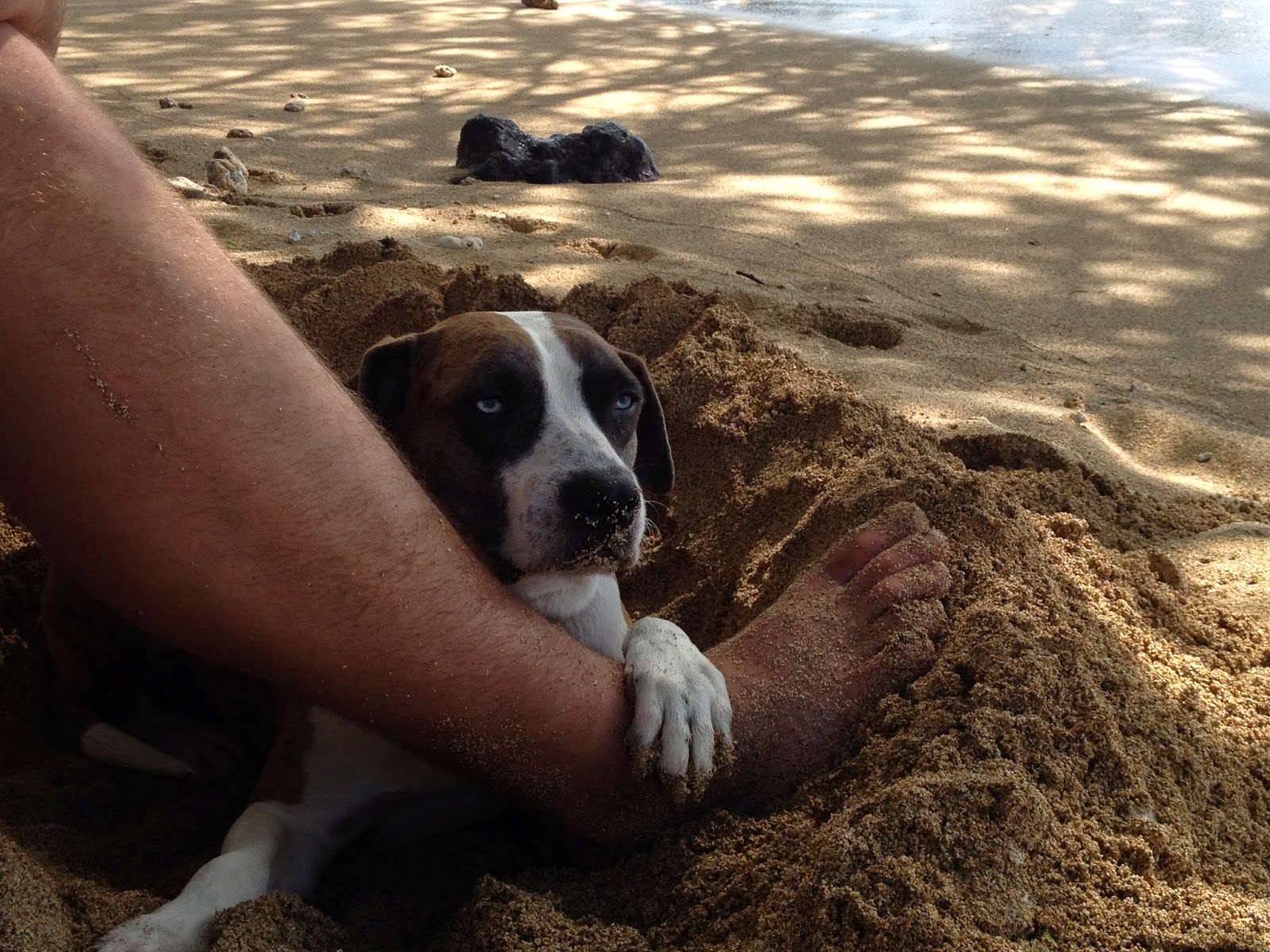
Kana relaxing with dad after a swimming with the SGDs pack.

Kahiko & Dora holding paws after hiking and playing.


Friday, May 30, 2014

Dog Sounds--Dog Apps/ Reference & Accessories

Dog Sounds


iPhone Apps for Dogs/ Dog Reference & Accessories
Updated:  August 10, 2013
FREE

In this new series on my blog, I will be reviewing the many iPhone apps available that have to do with dogs.  This will include helpful, informative, and fun apps.

This app is much more useful than some of the other basic dog sound apps.  This app includes sounds of domestic dogs and different kinds of wild dogs.  It also includes an "Attention" section that includes the dog teasing sounds like a cat, the door bell, and someone knocking.  The real bonus to this app is the section called "Body Talk."  This section gives you body postures for different moods of your dog. For example, how a playful dog's body looks compared to anxious or aggressive dog.

As with most of the dog sound apps, I believe they are not especially useful and are generally used to tease a dog, which I don't recommend.  However the Body Talk portion of this app makes it worth while.  Noticing body language in your and other people's dogs can be very helpful and I encourage everyone to have at least some understanding of dog body language.

The different dog sounds.

Wild dog sounds.

The dog teasing portion of the app.

Body Language.
This is the best part of this app.

Wednesday, May 14, 2014

Trainer Tips--Puppy Nipping

I have recently had many calls from people with new puppies having some problems with puppy nipping, mouthing, and biting.  So I have decided to do this month's Trainer Tips on this issue.


Dog Mouthing, Nipping, & Biting:

Somewhat like young children, a puppy learns to explore the world through his mouth.  It is very natural and normal for a puppy to use his mouth in many things, including biting and nipping.  It is up to us as the owner to teach our dog what is acceptable behavior, not only when it comes to using their mouthes, but overall as well.

First off, it is very important that you NEVER hit or slap a puppy (or any dog) for putting his mouth on you.  Doing this will generally only create more problems, not solve them.  Hitting a puppy can lead to distrust, fear, or possibly even aggression.  Obviously, that's not the path we want to go down.

Teaching a puppy bite inhibition can be down in several ways...

Training:

Technique #1:
The first technique I recommend to all clients is to pull away and loudly say "ouch! ouch!" when the puppy uses his mouth in an inappropriate way.
In a litter of new puppies, each puppy will be taught this lesson by his siblings.  When puppies play, if someone goes too far, the other will whimper and/ or yipe to let his playmate know he is hurting him.  This technique uses this same idea. When the puppy uses his mouth in an inappropriate or hurtful manner, pull away and loudly say "Ouch!"
(Be sure that the way in which you pull away from the dog will not cause you injury.)
When loudly saying "Ouch," make sure you are not yelling or using anger in your voice.  Remaining calm when using this (or any) technique will reinforce to the dog that you know what you are doing (even if you're not sure) and that the puppy should follow you.


After the puppy calms down, it is important to let him know we still love him.  After the behavior has passed, give the puppy petting and praise.  This will reinforce the behavior of being calm and not biting because the dog is being rewarded for being calm with petting and praise.  This is important!  The more you mark the good behavior and reward for it, the more your dog will want to engage in that behavior.


Technique #2:
Many times when a young puppy is nipping, he wants to play.  While using the technique listed above, it is also helpful to redirect the puppy to put his mouth on something appropriate, like a toy.

When the puppy uses his mouth too hard on you, use the technique above and say "Ouch!"  Still praise and reward the puppy for any calm behavior after the bite or nip.  Now your reward can be petting, or a toy.  Rewarding a puppy with a toy when they exhibit calm behavior after a bite or nip is 2-fold training.  First the puppy is being rewarded for not biting, second the puppies energy can be redirected onto the toy instead of the human.
Be sure the dog is either calm or performs a waiting behavior like sit before you play with the toy.  This way the dog is performing a behavior we want (being calm or waiting in a sit) and we are then rewarding this behavior with the toy while also redirecting the energy and biting onto the toy instead of us.
(When playing with a toy as a reward, be careful HOW you play.  Avoid wrestling, tug-of-war, and games of chase as these things can actually encourage mouthing behaviors.)


If you use these two techniques from early puppyhood, teaching bite inhibition is usually fairly easy.  Remember, it's important to be consistent.
Sometimes however, puppies just keep coming at you.  This happens for many different reasons.  Sometimes owners are unintentionally teaching or encouraging dogs to do so, some dogs have learned bad habits over many years that are hard to break, or some are even prone to dominant behaviors.  If you have tried the techniques above and failed, there are still things you can do.

First off, never stop trying Technique #2, redirecting the dogs energy onto appropriate items.  Unfortunately this is where people unintentionally create bad behaviors.  It is important to remember to give rewards as rewards for performing a desired behavior, NOT as a distraction from a current bad behavior.

Example 1:
I had a client who had been unintentionally rewarding her dog's bad nipping behaviors for years.  Although the owner had the right idea, they went about it in the wrong way.  Whenever the dog would get over-excited, he would start to get nippy around people's ankles.  The dog had biten several guests more than once.  In an effort to distract the dog, the owner would get out treats whenever company would come over, but the training she thought she was doing was far from what was actually happening.
The owner meant to use the treats as a reward for not going after people and nipping, but her timing was way off.  Instead of rewarding the dog for performing a desired behavior like moving away from the guest or laying down or sitting, the owner was rewarding the dog for biting.  Although the owner's intent was genuine, the training fell flat.  I'm always glad to see people who do their reading and homework, but it's all about the delivery.
So, when this dog would go for someone, the owner would shove food into the dogs face (not first requiring the dog to perform a desired behavior).  By doing this, the dog learned that attacking people that entered the home was highly rewarding.  Every time he attacked, he was rewarded with a treat.
      Take care that you are using Technique #2 in the proper way.
When I arrived for training, I basically needed to adjust her timing.  I reminded the owner to wait for (or encourage) a good behavior, something we want the dog to do, before rewarding with a treat.  While training with me, the dog (and owner) learned to move AWAY from the guest to get a treat.  This then taught the dog that giving humans that come into the home their own space is highly rewarding.


Body Language:

Although dogs do use vocalizations to communicate, most of their communication is done through body language.  This is something you should be aware of when training your dog.  Your body language tells your dog what you are really feeling.  Make sure you remain calm, standing tall and straight.  Things like leaning back, slouching your shoulders, and moving away makes you weak in the eyes of a dog.  You want your dog to learn you are the leader; that he must follow you.  So stand tall, proud, and calm.

Example 2:
When it comes to dogs that nip, body language is especially important to be aware of.  A dog that gets into a nipping behavior is constantly testing the humans and pushing his boundaries.  Unfortunately what ends up happening is the more the dog pushes, the more the humans retreat.  This is not what we want.  Instead of moving away from a dog that jumps up or nips and chases you, it is actually better to stand tall and move into the dogs space, while disagreeing with the bad behavior.  This must be done correctly and carefully.  (If you are at all unsure or afraid of your dog, please seek professional help as soon as possible.)

Example 3:  
As a trainer I've walked 100s of dogs all over the country.  Unfortunately many people do not keep their dogs contained when they should be.  Although this is NOT something I recommend you try if you do not feel comfortable, it serves as a good example of how important body language in dogs is.
     Many times while out on a walk I have been approached (or charged) by random dogs.  Now if you do not already have the dog you are walking under control, you will in no way be able to do this. When approached or charged by a random dog, I will keep the dogs I am walking behind me, stand tall, and move forward towards the approaching dog.  I will also yell something like "Hey! Get!"
Because the dog(s) I am walking is under control and behind me, this tells the random dog that I am in charge.  When I stand tall and move towards the approaching dog, this tells him I am not afraid and  that I am calm and confident.  This will usually deter an approaching dog.  Now do not think for a second that this is true of all dogs and will always work.  I have also been charged by a dog that I knew I could not stop and took off running to safety instead.  I simply want to use this as an example to illustrate the importance of body language to dogs.
     Now on the flip side, if I had been behind the dog I was walking and had a weak body language, that would tell the approaching dog the I was afraid and not in control.  The dog would most likely then come right up and either attack my dog or me.
     When in doubt, look for an easy escape, or try yelling to get the attention and help of other people near by.  If you are able, lift your dog onto something to get them out of harms way.  (Get yourself up there too if you can).  If you simply lift a dog, the approaching dog may bite you while trying to get at your dog.


Changing the Behavior:

Following these techniques can help you train your dog, but its equally important to include basic training in your program.  If your dog will not sit or come for you, why should he not bite you?  You must also train your dog in basic manners.  This will help establish leadership over your dog.  Remember to lavishly reward any and all good behaviors.  The better relationship you have with your dog, the easier it will be to train him to do anything you want (or to stop doing those things you don't want).  Remember that consistency is  important.

Finally, many times a nipping problem can be easily helped or even curbed with just a little more exercise.  Humans sometimes forget that puppies have TONS of energy.  And depending on your dog, they may be a high-energy type dog their entire lives.  Dogs need lots of regular exercise.  If they do not get this need fulfilled, they will find other ways to take out their frustrations, like nipping, chewing, and digging.  Keep your pet exercised and establish the rules.  Be consistent and use positive reinforcement, and you will be on the right path to a happy dog for life.


If you have tried all the things above and your dog has still been nipping or biting you for a month or more, it is time to seek professional help.  A nipping puppy can be a nuisance, but a full grown biting dog is a dangerous problem that can not be ignored.  Stop your problem behaviors before they get worse.


Thursday, May 1, 2014

Breed of the Month--Pomeranian


Pomeranian

Color:  All colors, variations, and patterns (but no white and black shadings).
Height:  7-12 inches
Weight:  3-7 lbs
Life Span:  13 to 15 years

Breed Health Concerns:  Hypothyroidism, patent ductus arteriosus, collapsing trachea, and patellar luxation.

Coat:  Double coat.  Ruff neck, fluffy, soft, thick undercoat; harsh, straight, long, glistening outer coat.
Country of Origin:  Germany

Visit the American Kennel Club for breed standards and more information.

The smallest of the German Spitzes, the Pomeranian is known as the Zwergspitz in many countries.  The breed originated in the German province of Pomerania.  In the 1800s, Queen Victoria's love of the breed steered the dog in a smaller direction.  Originally near 30 pounds, Queen Victoria's kennels bred the dog closer to its current size, usually no more than 5 pounds.  Noteworthy proponents of the breed include:  Marie Antoinette, Emile Zola, and Amadeus Mozart.

Pomeranians are quite active and enjoy doing most anything with their family.  The Pom excels at obedience, and in agility and the show ring.  This toy dog is intelligent, active, and alert.  The Pom can make an excellent watch dog, as he barks any time he is suspicious.  Training this breed from day one is very important so the dog does not develop a spoiled nature.

Exercise:
Although the Pomeranian is small, he still has tons of energy and needs regular exercise.  Daily walks and outings are important for the Pom, as he loves to accompany his family anywhere.  Short play times of activity are also important for the Pom.
Grooming:
The fluffy coat of the Pom must be given regular attention to keep him looking his best.  Brushing the Pom's long shedding coat several times a week is recommended.  Extra care should be taken to make sure his eyes stay clean, and that his teeth receive regular check-ups.
Training:
Socialization from early puppyhood will help the Pom gain confidence, and training will be a breeze.  Using positive reinforcement training with the Pom makes it easy to teach basic obedience.  The Pomeranian is eager to learn and can excel at tricks and agility.


A client's Pomeranian getting a hair cut…


Thursday, April 10, 2014

Trainer Tips--Keeping pets off furniture.

Have problems keeping your pets off the furniture?  There are many simple, handy things you can purchase or do to help keep your pets off the couch, bed, or counters while you're away.  I would like to remind everyone that these are helpful tools.  Using any of these things should also be accompanied with positive reinforcement training that teaches the dog where he is not to be, and where he should be instead.

As a trainer, I highly recommend you do not allow your pets on the furniture.  When first bringing a new puppy or dog into your home, it is vitally important to establish leadership.  Not allowing your pet on the places that humans usually rest is one easy way to help do that.  Be consistent.  If you do not allow your pet on the furniture, then that is the rule, NO exceptions.  For people who do wish to have their pets on the furniture, they should only be allowed up when invited by the human.  The dog should not make the decision to get on the furniture, the human makes the decision to invite them up.

If your dog (or cat) likes resting with you on the couch or bed and they are not allowed (or you are training them to be off these surfaces), one important thing you should have is a place that they should be on.  This can be their very own pet bed, blanket, or area located near where you rest.  Pets have a need to be close to us and rest near where we do.  So placing a proper resting place near your couch and bed for your pet to go to can help train them out of going on the furniture.  We are redirecting the bad behavior of going on the couch, into a good behavior of laying on the pet bed.
Luke sharing a bed with Nekita.

Along with having a proper resting place for your pet, you should train your pet to go to this place.  When the pet jumps up on the couch, say "Uh-oh" and lure or gently lead them to their bed using a command like "bed" or "place."  Remember to stay calm.  When they reach the pet bed, mark the behavior with a "Good!" then reward.  Rewards can be many different things, and are different for each dog.  Some common rewards include: petting, praise, toys, and food.

Now onto the good stuff…

Below are some various helpful aids and things you can do to help keep your pets off the furniture during the training process.  Basically you want to make the bed or couch or counter top an area that is unpleasant for the pet to rest on.  This can be done in several ways.

Store Bought Options:
Pet stores all over have various deterrents you can use to help keep pets off furniture.
This one can be thrown on top of almost anything.

The plastic pokes up, making it uncomfortable for your pet to lay on.

This is a pet deterrent that makes crinkle sounds if touched. 
Many dogs will be deterred by the loud noise.
Some of these also include a pressure-sensitive shrieking alarm.
(Never use these with a fearful or anxious dog.)

There are various sprays you can apply to areas or furniture to help deter your pet.

Bitter Spray is usually used to deter chewing,
but can, in some cases, help deter pets from certain areas as well.


Homemade Options:
There are many every day items around your house you can use to help deter your pets from certain surfaces in your home.

Booby Traps:
Use empty soda bottles, or empty cans filled with coins (and taped back up) to booby trap forbidden areas.  When the pet jumps up, he will be startled by the noise and leave the area.

You can use every day tin foil and place it over forbidden surfaces.  The crinkly noise it makes will deter pets from resting on this area.


I have also used tape (scotch or masking) and rolled the tape into a loop with the sticky side out.  Then barely stick the tape to the forbidden surface.  When your pet comes to the area, he will get sticky tape stuck to him and leave the area.  (This is especially helpful for cats or small dogs who like to get on counters.)


Remember prevention and management.  It is helpful to make the forbidden area less accessible.  Push in chairs around tables, move the coffee table into the couch before you leave, or close off access to rooms. 

If you teach your dog what behaviors are acceptable, and reward them for doing good behaviors, your dog will want to continue to engage in good behaviors.  Remember to mark the good behavior!  If you walk by and the dog is lying nicely on his bed, give him a calm "Good!" and reward with some soft, calm petting.  When you notice the dog going to the forbidden area, clap your hands to snap the dog out of the intended action, then redirect the dog to the proper resting place, the dog bed.  When the dog goes to the bed, mark the behavior with your "Good!" and reward.

Don't forget to give your dog proper exercise every day!


Tuesday, April 1, 2014

Breed of the Month--Portuguese Water Dog


Portuguese Water Dog

Color:  Black, brown tones, white, combination black or brown with white.
Height:  Males:  19.5-23 inches/  Females:  16.5-21 inches
Weight:  Males:  42-60 lbs/  Females:  35-50 lbs
Life Span:  11-14 years

Breed Health Concerns:  Addison's disease, hip dysplasia, follicular dysplasia, progressive retinal atrophy, dilated cardiomyopathy, and glycogen storage disease.  

Coat:  Two varieties (both single coat):  Gentle waves, OR curly with compact, cylindrical curls.  Both coats have a slight sheen.
Country of Origin:  Portugal


Visit the American Kennel Club for breed standards and more information.

Known to be an indispensable partner to the fisherman of coastal Portugal, the Portuguese Water Dog may have assisted in this way as far back as 700 BCE.  The PWD's job was to herd fish into the nets of his fisherman, carry messages and equipment between boats, and retrieve objects from the water.  The PWD's size and strength make him hearty enough to navigate through rough water.  Combined with his dense, waterproof coat, the Portuguese Water Dog is unstoppable in the water.  

The breed came to the U.S. via England in 1958.  A family from Connecticut fell for the dog and imported a puppy directly from Portugal.  The Portuguese Water Dog Club of America (PWDCA) was formed in 1972 and by the early 1980s, the breed was flourishing in the United States.

The PWD is great with children, lively, and sensible.  A working dog, the PWD will not stop until the job is done.  He enjoys swimming, retrieving and herding.  The PWD is level-headed yet fun loving, and is very devoted to his family.

Exercise:
The Portuguese Water Dog is an extremely athletic dog and requires regular, vigorous exercise.  As his name may indicate, his favorite activity involves the water.  Being a working dog, the PWD should be involved in doing regular household chores.  He loves to play.
Grooming:
Although practically non shedding, the coat of the PWD needs regular maintenance.  The coat of the Portuguese Water Dog should be combed, trimmed, and brushed regularly.  The coat should be clipped every 6-8 weeks.
Training:
The Portuguese Water Dog is a high-energy dog and training should begin as soon as possible.  The PWD eagerly takes to positive reinforcement training and enjoys having a job to do.  It is important to give the PWD guidance and direction, but with positive training, he can learn almost anything.


I was lucky enough to train with a Portuguese Water Dog named Tele.  Tele had some issues with golf carts, so we worked on several different training activities on the leash, most of which involved golf carts of course.  Below are a few of the pictures I caught during our training.

Tele paying attention to her owner as a golf cart goes by.

Ahh, a refreshing reward of water.

Tele and mom.

Thursday, March 20, 2014

Trainer Friends

For my friends in the mid-west, I wanted to share a great dog training opportunity.  This session will be taught by an amazing dog trainer, and my former mentor, Inga From.  Inga is one of only a handful of people in the United States that teaches positive gun-dog training.  If you are looking to do some hunting with your dog, or have a dog that loves to fetch, I highly recommend you consider taking this seminar with Inga.  I was privileged to have attended former Gun-Dog Training weekends with Inga, and they are quite informative and fun.

Details and registration available at www.PositiveGunDogsMN.com


Field Sport for the Family Dog
Intro weekend

Positive Gun Dogs of Minnesota welcome
Inga From, CDBC, CPDT-KSA
As She Presents Her Two-day Beginner Positive Field Dog Seminar
May 3rdth & 4th, 2014
Stone Mountain Pet Lodge–Blaine, MN
About this seminar:
An urban field sport for the family dog is an opportunity to see what your sporting breed dog was bred to do or for any dog that loves to fetch!
Effective and efficient dog-friendly training methods for field dogs without the use of force fetch training or e-collars.
Seminar Overview:

Day One:
• Overview of positive field sport’s

• Positive training basics

• Assessment of foundation skills

• Introduction to scent work

• How to teach a retrieve with positive training

Day Two: (outdoors)


• Into the field

• Introduction to field training

• Individual time with instructor

• Level 1: K9 Field Sport Testing
Cost: Two-day working spot for one handler & one dog $235
Team Discount: Two-day working for two handlers & one dog $270
Two-day auditor/observer spot-no dog $180


Inga From, CDBC, CPDT-KSA  My Bio
Certified Dog Behavior Consultant
 (International Association of Animal Behavior Consultants)

Certified Professional Dog Trainer 
(Certification Council for Professional Dog Trainers)


Offers Positive Training for dog owners and their dogs.

Association of Pet Dog Trainer’s national award winner

Positive Training based on the LIMA (Least Invasive Minimally Aversive) principle.

Professional Member of the Association of Pet Dog Trainers.

Inga specializes in shelter/rescue dogs. She has worked in shelter settings for over 10 years. Five of those years were spent at a local humane society where she served as the expert for the shelter in behavior and training. 

Inga Offers:


Monday, March 3, 2014

Trainer Tips--Picking up Poop in the Dark

So I was hanging out with some neighbors and their dog the other night and we went out to the yard for a last dog potty break before bed.  Many times I see people bring flashlights or use their cell phone to find where the poop landed, but what happens when you have none of these things and are searching for it in the dark?

Well this month's Trainer Tip is helpful, yet extremely simple.  It's something I've been doing for years now.  Whenever my dog(s) stop circling and go for the Number 2, I point my foot in the direction of where it will land.  That way you don't have to stare and watch, which of course no one really wants to do, but you also won't lose it in the dark or bad weather and spend time having to search.  Like I said, simple, but very helpful.

So from now when you take your dog out at night to do his business, just remember to point your foot the direction of where the poop will land and you won't lose it in the dark.

Happy night walking everyone!

Saturday, March 1, 2014

Breed of the Month--King Shepherd


King Shepherd

Color:  Sable, bicolor (mostly black with red, cream, or tan), black saddle with red, gold, tan, silver, or cream markings, solid black, solid white.
Height:  Males:  27 inches/  Females:  25 inches
Weight:  Males:  100 lbs/  Females:  80 lbs
Life Span:  11-14 years

Breed Health Concerns:  May include hip dysplasia.

Coat:  Two varieties:  1) Coarsehaired:  has dense, straight outer coat with varying hair lengths, 
2) Longhaired:  has a longer coat but is not always straight.
Country of Origin:  United States

Visit the American King Shepherd Club (AKSC) for more information.

It is unknown just how many breeds went into making the King Shepherd, but among those credited most often include:  the German Shepherd Dog, Alaskan Malamute and the Great Pyrenees.  American breeders David Turkheimer and Shelley Watts-Cross are credited with the development of this breed.

Originally developed to get away from the many breed health problems of the German Shepherd Dog, the King Shepherd was developed to serve as both guardian and shepherd.  He is most defined by his massive head.  The King Shepherd is strong, rugged, and solid.  The breed was developed as a protector, but also as a working and family dog.  He is poised, self-confident, and alert.  He may be somewhat wary of strangers, as it is his instinct to protect his family.

Exercise:
The King Shepherd is most satisfied when he has work to do.  This breed needs plenty of daily walks and regular exercise to be happy.  If not properly exercised, the breed may become destructive.  Consider this breed a high energy breed.

Grooming:
Both coat types of the King Shepherd need regular brushing a few times each week.  His undercoat will shed and must be kept clean from dead hair.  The longhaired King Shepherd's coat will need a bit more attention as it is more likely to become caked with debris and tangled.

Training:
Socialization from an early age is extremely important for this large breed.  The King Shepherd is obedient and intelligent and training him can be a real joy.  It is very important to build a good relationship between owner and dog right away.  As with the German Shepherd Dog, the King Shepherd as a breed is very owner/ family orientated.