Monday, October 14, 2013

Jack

We recently had a guest dog with us, Jack, a 10-year-old black lab.  Although Jack is a very sweet boy and great with other dogs, he reminded me how important training really is.  This dog had ZERO leash skills and was extremely pushy around doors and with food.  In the two weeks he spent with us, I significantly improved his leash skills (at least he wasn't dragging me around any more), and taught him patience and to respect the leader, which of course is me.  His behavior improved greatly during his stay.  Below are some picture of the fun stuff we did.

Jack.

Jack's favorite activity is fetching a ball.

He's a little out of shape, so he had to lay to drink after playing fetch.

Lazy, but happy.

Caravaggio & Jack playing fetch at the beach
with new friend, 4-year-old Jason.

It's true, labs love to swim!

Jack & Caravaggio shaking off.


Many people I train are often concerned about taking away the "natural dog" behaviors.  Sometimes people believe that giving dogs rules and boundaries takes away from them just being a dog.  To that I have only this to say, look at the pictures above...do these dogs look happy?  There are rules, boundaries, and limitations for every single dog that comes into my house, but my dogs (and guest dogs) are very happy.

Caravaggio, Nekita, & Jack enjoying sunset with us after a hike.

Happy Jack.


I think he had a good time :)


Basic Manners Class #2


I'm very excited to have started a new Basic Manners class on the West Side recently.  Although I always enjoy classes, having an especially large class can be extra fun.  This class has 7 dogs in it and everyone is very excited to be here.  I always love helping people who are ready and willing to put in the work.  Hopefully I will be able to see just how hard they've all been working at this week's class.

Below are some pictures from week two of this Basic Manners class.  This is the first time all the dogs get to meet each other, so the energy and excitement of week two is high.
(I was happy my friend was able to stop and take some awesome pictures for me as well.
Thanks Megs!)

Athena describing the first lesson for the day.

Class participants.

Athena working with Keani & mom Barbara
on Loose Leash Walking.

Athena working with Kengie & mom Sanchi.

Athena showing lab, Kuma, how to walk on a leash
with family watching how its done.

Kuma watching Mocha & Kengie say hello.

Hanging out after class.


Tuesday, October 1, 2013

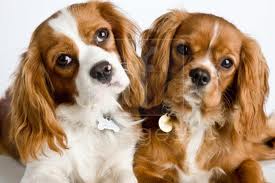
Breed of the Month--Cavalier King Charles Spaniel


Cavalier King Charles Spaniel

Color:  Chestnut markings on white background (Blenheim), tricolor, rube, black and tan.
Height:  12-13 inches
Weight:  11-18 lbs
Life Span:  12-14 years

Breed Health Concerns:  Hip dysplasia, patellar luxation, Chiari-like malformation (CM), syringomyelia (SM).

Coat:  Long, silky coat of moderate length, feathering, straight or slightly wavy.
Country of Origin:  Great Britain

Visit the American Kennel Club for breed standards and more information.

Toy spaniels were first developed as hunters is Great Britain.  By the 1500s, the dogs were no longer hunters and became companions of the wealthy.  King Charles I and King Charles II both adored and kept the breed in the 1600s.  The name of the breed was derived from King Charles II.

The breed was crossed with the Japanese Chin and Pugs during the Victorian era, but eventually came back to its original "Blenheim Spaniel" look in the 1920s when American Roswell Eldridge offered money to breeders to bring the breed back to its "old style."  Recognized by the American Kennel Club in 1944, the breed has gained extreme popularity over fast few decades.  Famous admires of the breed include President Ronald Reagan and Princess Margaret of England.

The Cavalier King Charles Spaniel is a good natured dog that enjoys the company of others.  This breed is large enough to go on adventures with his family, but still small enough to fit comfortably into your lap.  The Cavalier King Charles Spaniel is generally well-behaved, and a calm, loving member of his family.  This breed is extremely people oriented and does not generally like being left alone.  The Cavalier King Charles Spaniel is great with all people, including children, and other pets.

Exercise:
The Cavalier King Charles Spaniel is not a high energy dog, but still requires regular daily walks.  This breed will easily adapt to the activity level of his family.  He enjoys playtime and regular outings, but can also be content to sit at home and relax with his family.

Grooming:
The coat of the Cavalier is easily kept clean and nice with regular brushing a few times per week.

Training:
Although the Cavalier King Charles Spaniel may sometimes need extra help with potty training, this breed is generally easily trained.  The Cavalier is eager to please and will be easily trained using positive reinforcement methods.  I highly recommend this breed to anyone!


Cavalier King Charles Spaniel, Wicket.
Wicket is a very sweet girl that definitely aims to please during training.

Wicket & her mom practicing some training.

Saturday, September 14, 2013

Lahaina Basic Manners Class starts Oct 2nd


Such Good Dog's will be starting new Basic Manners - Level One dog training classes.
This class will be held in Lahaina.
Wednesdays 5-6 p.m.
(October 2nd - November 6th)

Contact Such Good Dogs to sign up now!!!!
808-463-4684
suchgooddogs@gmail.com
(Email us with you name, phone #, email address, dog's name, breed, & age.)


Basic Manners Level One is a 6-week, one hour per week class.  Each week you will learn new things to take home and practice with your dog.  Basic Manners is taught using positive reinforcement training, combined with energy balance.  Items covered in this Level One class include:  Food Lure, Marker Word, Watch Me/ Look, Come when called, Loose Leash Walking, Impulse Control, Sit & Auto-sit, Down, Stand, Stay, Drop It, and Leave It.


The cost for this class is $150 CASH.  Please bring this with you the first day of class, along with your pet's vet records.  I do not need to keep any vet records, but I DO need to see them.  Your pet should be up to date on all shots including Parvo, Distemper, and Rabies (if your pet is from outside of Hawaii).  These vaccinations are required prior to beginning training.  Please check your records before the class begins to be sure your pet is up to date on everything.  Also please have your vet's information (clinic name, phone #, etc), as you will need this to properly fill out training paperwork.


For the first week's class you do NOT bring your dogs.  This first class is information, and the most important class.  Please bring paper and a pen for taking notes.  Handouts will be given each week at the end of class.

ANY dog breed of ANY age is welcome (and encouraged) to take the class.


Class will be held at a park in Lahaina.


Contact Such Good Dogs to sign up now!!!!
808-463-4684
suchgooddogs@gmail.com


Can't wait to meet you.


Thursday, September 5, 2013

Trainer Tips--Other helpful commands

I sometimes forget about all the other helpful commands/ cues you can teach your dog.  These are not things generally taught in most group classes, but sometimes come up in private lessons.  Regardless, they are helpful cues to teach your dog.  So I am going to share them with you.

These commands/ cues are in addition to, what I consider, the basics.
Basic Commands:
Look/ Watch Me
Come when called
Sit
Down
Stand
Stay
Drop It
Leave It
Walking properly on a leash

Remember, as with all cues, do NOT get in the habbit of repeating yourself.  Say a cue one time, and one time only.  If the dog does not respond, WAIT 30 seconds to a minute.  Then give a No Reward Marker of "Uh-Oh," reposition yourself (this helps "reset" the training), and try again.  Always also remember to give your dog their Reward Marker, "Good" or "Yes," every single time the dog does as asked.  EVERY TIME!  The Reward Marker of "Good" or "Yes" given every time the dog performs as desired is vitally important to continue to improve your dog's behavior and response to commands.
Also remember, as with any new command/ cue, you may use any word you wish for the cue, as long as you consistently use that same word.


OFF:
I use this cue for a variety of things.  The most common use is tell a dog to get off of the furniture or off of a person.  To teach this cue is pretty simple.  It is helpful to also teach the cue "On" while teaching the cue "Off."  To do this you basically food lure a dog onto a piece of furniture, as he jumps up, you say "On."  Then food lure him off the furniture while saying "Off" as he is jumping down.  Remember to use your "Good," then treat, each time he obeys.  As he gets better, starting pointing to the spot and saying "On," then pointing away from the spot towards the floor, and saying "Off."

This cue is also helpful for other things including urine marking, possessive behavior, and dominance.  For example, if you have a dog that likes to pee on every tree and bush, start using your cue of "Off" the instant the dog gives you a signal that he is going to mark.  Some distraction (a clap of the hands) may also be helpful used with the command "Off."  Another instance is a dog who resource guards treats or toys.  You can use the command "Off" to teach him to back off of those items.


GO HOME:
I specifically chose the words, "Go Home," for this cue because I have witnessed people telling it to random wandering dogs.  So this can be helpful to teach your dog in case one day he gets lost and someone tells him to "Go Home."  This cue is also pretty easy to teach.  Basically any time we come back from a walk or car ride, I will point towards the door of our place and say, "Go Home."  Your dog may or may not be on a leash for this.  When the dog moves in the correct direction towards your door, give your "Good."  When your dog gets to the actual door, give a very excited "Good!"

As with any cue, the more you practice, the better your dog will get.  I can now tell my dogs from several hundred feet away from our door to "Go Home," and they will do so.  (We currently live on the second floor and they know to go upstairs and to our door.)


BED/ KENNEL/ CRATE:
This cue is often helpful.  This training usually begins with food luring your dog onto his bed or into his crate and adding your cue word of "Bed" or "Kennel" as he is going to his destination.  Again remember your "Good" every time the dog does as asked.  As your dog gets better, you can move onto pointing at the bed, and saying your cue word (looking at it also helps).

Caravaggio in his kennel.

Wicket relaxing in her kennel.

Nekita sharing her bed with Luke.


PAW:
Some people also use the word "Shake."  I personally recommend using the word "Paw," for two reasons.  Reason one, I use the word "Shake" to mean shake the water off after swimming or a bath.  Reason two, using the word "Paw" means you can also apply the command to leash mishaps.  For example, if you have a dog that has a tendency to step over his leash and get tangled, next time, say "Paw" while lifting the paw that is tangled and swinging the leash out.  Doing this over time will improve your dog to the point where you can be walking, see a leash tangle, say your command of "Paw," have the dog automatically lift the leg that is tangled, be able to swing the leash out of the way, and continue on your way.

Teaching "Paw" as in "Shake hands" is also a great trick for your dog to learn.  Furthermore, dogs should be able to be touched on their feet (and anywhere else) without reacting negatively.  Teaching your dog this cue will not only give him a great trick to show off, but will help him remain calm during veterinarian exams.


WAIT:
This is one of my favorite cues.  This command can be helpful in many situations.  First off there is a difference between wait and stay.  The command "Stay" always means, stay here until I come back to you (the dog).  Wait means, stay here until I give you something else to do (followed by another command, such as come, or release).
Before teaching the command "Wait," I very highly recommend that you teach your dog a reliable "Stay" cue first.  It is very easy for a dog to wait for a second and then run to you.  It is much harder for a dog to learn to stay in one spot until you return to them.  Once your dog has a reliable "Stay" cue (you can go out of sight and back without the dog moving), only then should you move onto teaching the "Wait."


To teach wait, you start it front on the dog, put your stop sign hand signal up (same as Stay), and give the command "Wait."  Back up a few feet, stop, say "Good," wait a few seconds, then call the dog to "Come."  Repeat.

Another way to teach this cue is with a long line (20-30 foot leash).  I often teach this to Adventure client's dogs while out on a hike.  I let the long line drag for most of the leash and only hold the last part of the leash.  BEFORE the dog reaches the end of the line, I step on the leash on the ground and say my command of "WAIT" right before the dog gets to the end of the leash.  If done correctly, your cue word will coincide with the exact time the dog reaches the end of the line and bounces back.  (This is best done with a harness.)
Dora first learning "Wait" using a long line.


OUT:
This is the cue I use to tell a dog to remove themselves from a room, location, or enclosure.  To teach the "Out" command from a room, simply start with you and your dog in any room.  Point away from the current location and say "Out."  Slowly and calmly back your dog with your legs out of the room (while still pointing out).  Once the dog crosses the line (past where you want them out of or past the doorway), say your "Good," and reward.


ALERT:
This is a command to teach a dog to bark, make noise, and let someone know they mean business.  When my husband and I lived in the city, this was very helpful.  We use the command "Who is it?" with emphasis on the entire phrase.  I say it in a way that is meant to get the dogs excited, start barking, and go see who might be at the door or in the yard.

Be very careful with this command.  If your dog has ANY aggressive tendencies what-so-ever, please do not use this command.  Teaching a proper Alert response is about letting the owner know someone is there, and to potentially deter dangerous persons from your house, yard, or current location.  This cue is NOT intended to get dogs so excited that they attack and bite randomly.  If you are looking into teaching your dog protection work, this cue should not be taught until you have entered protection training.  A dog properly trained in protection will not randomly attack and can be approached and pet normally.


Sunday, September 1, 2013

Breed of the Month-- Alaskan Malamute


Alaskan Malamute

Color:  Solid white, mostly white with black to light grey shadings, red, sable.
Height:  Males:  25-28 inches/ Females:  23-26 inches
Weight:  Males: 85 lbs/ Females:  75lbs
Life Span:  10-12 years

Breed Health Concerns:  Bloat, cancer, coat funk, epilepsy, diabetes, eye problems, autoimmune hemolytic anemia, hemeralopia, hip dysplasia, immune diseases, hypothyroidism, and skin problems.

Coat:  Double boat.  Dense, woolly, oily undercoat.  Coarse, thick outercoat.
Country of Origin:  United States

Visit the American Kennel Club for breed standards and more information.


Originally bred by Malamute Eskimos (now known as the Kobuk) in the harsh environment of northeastern Alaska, the Alaskan Malamute was bred to literally "pull his weight."  The Eskimos needed a dog that was reliable, intelligent, and strong enough to withstand the cold.  The Malamute was designed to carry large loads over long distances.

The Klondike Gold Rush of 1896 brought many settlers to the area who quickly learned the value of a good sled dog.  Although many tried to mix the Malamute with smaller, faster dogs, in the end the breed was returned to the true Malamute type, and been preserved since.

It is said that the Kobuk gave great care to the Alaskan Malamute and the breed has a better temperament because of it.  The Alaskan Malamute is very affectionate and playful, and is a loyal devoted companion.


Exercise:
The Alaskan Malamute was bred to be a hard working dog, and therefore will require plenty of exercise as a family pet.  This breed requires vigorous daily walks, and a great deal of daily mental and physical exercise.  Many Alaskan Malamute owners may find it helpful to engage their dog in organized pulling or other contests.

Grooming:
The coat of the Alaskan Malamute almost constantly sheds, and therefore requires regular grooming.  About twice a year, his coat will also "blow out."  When this happens, large clumps of fur fall out, and his coat will require extra attention.

Training:
Because the Alaskan Malamute was bred to be independent, this breed may be more challenging to train.  The Alaskan Malamute must start training as early as possible.  This breed responds best to positive, motivational training.  The Alaskan Malamute is smart and strong, and must be challenged accordingly.


Thursday, August 15, 2013

Trainer Tips -- Why Spay/ Neuter Your Pet?

I often have clients ask about spaying & neutering their pets.  I also have some clients who want to have "just one litter" with their pet before spaying or neutering.  This blog is to tell you all about why you SHOULD spay and neuter your pets.

Currently, an estimated 3-4 million pets are euthanized in the United States each year.  Now really take a moment to think about that number.  Four million animals killed each year.  This is a number that we can dramatically decrease by helping spread knowledge and information about the importance of spaying and neutering your pets.


Why Spay or Neuter your pet?
*Improve your pet's health
*Reduce unwanted behaviors
*Save money on pet health costs
*Reduce the number of unwanted/ homeless pets killed 


Improve your pet's health:
According to a USA Today article (May 7, 2013), "Neutered male dogs live 18% longer than un-neutered male dogs and spayed female dogs live 23% longer than unspayed female dogs."

A large portion of the reason unaltered dogs have shorter life expectancies is due to the increased urge to roam.  This exposes them to fights, diseases, getting hit by cars, and other possible dangers.  Neutering males prevents enlargement of the prostate gland, testicular cancer, and reduces the risk of perianal tumors.  Spaying a female before her first heat cycle greatly reduces the risk of breast cancer and prevents uterine cancer and infections.

On the negative side, some sources state that spaying or neutering an animal before one year of age contributes to an increased likelihood of developing osteosarcoma (bone cancer).  

Your veterinarian can also explain many of the benefits and possible risks.  A veterinarian is the ideal person to talk to if you have reservations about altering your pet.  Based on your animal's breed, age, and individual health, your vet will recommend the best time to spay or neuter your pet.

Spaying and neutering helps prevent passing on any genetic defects, diseases, or undesired traits to future generations.  Remember, lets leave the breeding to the professionals.  Good professional breeders breed for health and temperament.  Most of the time when people want to have "just one litter" it is because of a personal reason.  This could be just because you think your dog is the cutest dog in the world (not actually a good reason to breed).  Maybe your vet told you your dog has excellent hips...that doesn't mean he/she is a perfect candidate for breeding.  

In the end, the best health benefit to your dog is living a happy, stress-free life.  
Mating and having the urge to mate is stressful.  
Carrying, giving birth to a litter, and raising puppies is stressful.

Also consider your own health and the health of the human population.  Pet over-population contributes to the spread of germs and diseases.  Pet feces already litter many public areas and parks, contaminating the soil and surrounding areas, and spreading diseases.  

Maui has a huge problem with Parvo (Canine Parvovirus).  This is a disease that is especially fatal to puppies and young dogs.  Many young dogs on Maui must be "quarantined" to protect them from this disease.  This means that dogs receive less socialization and outings at a young age, the time when these things are most crucial.  The Parvovirus is spread through feces, and can live in the ground for 6 months to a year.

The most concerning disease spread by animals is Rabies.  This disease can spread across species, and therefore may be easily spread to humans.  An estimated 55,000 human deaths occur each year due to Rabies.  Dog bites are responsible for 97% of human Rabies infections.


Reduces pet's unwanted behaviors:
Neutering your male dog can help prevent several unwanted behaviors including:  marking, aggression,  mounting, humping, barking and the urge to roam.  (Many of these behaviors will also occur in un-altered females).  The overwhelming urge to mate can even contribute to the dog's overall behavior.  The urge to mate contributes to increased anxiety, stress, and aggression.  

I like to tell my clients to think of it this way...we as humans also have certain urges.  Imagine having these urges your entire life and NEVER being able to do anything about it (or only having that one time out of several years).  It would most certainly be very frustrating and would stress out anyone!  Stress causes us to do things we wouldn't normally do.  The same is true for your dog.  Stress and anxiety highly increases the likelihood that your dog will develop unwanted behaviors (or worsen the ones that already exist).


Dogs who are spayed and neutered are more likely to be more social with other dogs and exhibit less aggressive tendencies, because there is no need for sexual competition.  Altering your pet will NOT change his/her natural instincts or personality.


Save Money on pet Health Costs:

I often hear the argument that having a pet spayed or neutered just costs too much money.  To this argument I say, "If you cannot afford to pay for your pet to be spayed or neutered, you cannot afford a pet."

We love animals.  I get it.  If I could afford it, I would have at least 5 dogs by now, but I can't afford the expense at this time, so I don't.  Part of being a good pet owner is being responsible.  Having a pet can be very costly, especially in the first 1-2 years of the animal's life.  Before considering adopting a new member into your family, you must really consider the cost involved.  It's not just about food and toys.  Pets require regular vaccinations and monthly preventative medicines such as Frontline and Heart worm pills.  You must also consider what might happen if your pet gets sick.  An extra, unexpected trip to the vet for a simple illness may end up costing hundreds of dollars.  You just never know.  I had my own personal experience of a severely large unexpected vet bill.  A few years ago, Nekita was found to have a lump when we were at our yearly vet exam.  She had to have surgery to have it removed.  Luckily for us, the surgery was the solution to her problem.  But the event still ended up costing us over $1000.

If not being able to afford the procedure to spay or neuter your pet is still your argument, consider the costs of having a litter of puppies.  Feeding, de-worming and giving first shots to an entire litter far outweighs the cost of spay or neuter.  Plus consider if your female dog has complications during her pregnancy or birthing.  Complications like these could end up costing thousands!

Renewing your pet's license may also cost you more if your pet is un-altered.  Many local governments have higher fees to license a pet that has not been spayed or neutered.  

Having an un-altered female also costs more in clean-up.  Adult females usually come into heat 2-3 times each year.  Each time this happens, they have a sort of dog period (bleeding).  It is therefore necessary to have a doggie undergarment and change doggie pads during this period (1-3 weeks).  This is an added expense.  Along with the unpleasant task of changing pads on your dog's diaper, what if she has an accident?  Dog accidents (urine, feces, or other bodily fluids) must be cleaned with an enzymatic cleaner.  This is the only way to actually get the smell out.  Cleaning with regular household cleaners may mask the smell to us, but the dogs know it's still there and the scent can encourage further accidents or marking.

If you are still concerned about cost of spay and neuter, most local organizations offer Spay & Neuter Clinics where you can get your pet altered at a drastically reduced price.  
Please check out these places:


Reducing the Numbers of Unwanted Pets:

As stated above, an estimated 3-4 millions pets are euthanized in shelters across the United States each year, and the number is still growing.  If nothing else in this article convinces you to spay or neuter your pet, let it be this:  save the life of a pet that is already in need.

Again I will remind you, proper pet ownership means being responsible.  That means if you breed your animal, YOU are responsible for all the resulting offspring, and any possible further offspring in the future.  Say you breed your dog and you have 5 puppies.  By some miracle, you find them all homes.  Then 1 of the 5 gets taken to the shelter because of a move.  The other 4 puppies have fabulous homes but one of those owners decides to breed their puppy and produces a litter of 8 more puppies.  Say they can only find homes for 5 of the 8 puppies.  Three of those puppies end up in the shelter.  That's now 4 dogs that have no home and will potentially be euthanized because you wanted that one litter.  I could go on, but I'm hoping you get the point.
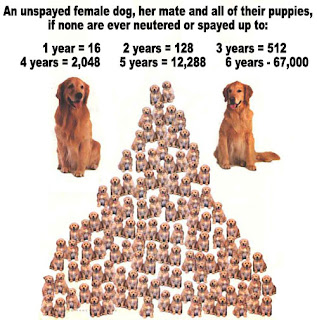


Please leave breeding to the professional, responsible breeders who breed specifically for health and temperament.  Breeding your cute dog, purebred or not, because you want to is extremely selfish and is only adding to the ever-growing problem of animal over-population.

*Special Note*
Here's a good example of how out of control the animal population can get.  The Maui Humane Society estimates that there are over 200 thousand ferrel cats on the island of Maui.  
This does NOT include cats with loving homes that are being cared for.  
There are 200 thousand ferrel cats roaming around, getting in fights, begging for food from tourists and passers by, and creating more cats.  This is a problem.  If we don't share our knowledge and educate others on the reasons to spay and neuter their pets, our dog population might not be far behind.  

I already see cats hit by cars on the highway regularly...I really don't want to start adding dogs to that occurrence!

Please spay and neuter your pets!


Thursday, August 1, 2013

Breed of the Month--Miniature Bull Terrier


Miniature Bull Terrier

Color:  Pure white, white with markings, and color predominating
Height:  10-14 inches (no more than 14 inches)
Weight:  25-35 lbs
Life Span:  10-14 years

Breed Health Concerns:  allergies, congenital deafness, primary lens luxation, mitral dysplasia, compulsive tail chasing, and subaortic stenosis.

Coat:  Harsh, flat, glossy, short; in winter a soft-textured undercoat may be present
Country of Origin:  England


Visit the American Kennel Club for breed standards and more information.

As with its standard cousin, the Miniature Bull Terrier was originally created from bull and terrier breeds.  As stated in my previous post, the Bull Terrier breed was established by Englishman James Hinks in the 1850s by crossing a Bulldog with the white English Terrier (now extinct).  The Bull Terrier was bred for agility, tenacity, and endurance.

Bull Terriers ranged from as little as 3 pounds up to 50 pounds at one time.  The smaller version of the Bull Terrier with the same features of its larger-sized counterpart was admired by many breeders.  They continued breeding these smaller versions to make a more manageable house pet.  Although the Miniature Bull Terrier breed was shown in the United States in the early 1900s, the breed was not accepted by the American Kennel Club until 1991.

The best word to describe the Miniature Bull Terrier is ACTIVE.  This compact bundle of fun is playful and clownish.  This breed enjoys being the center of attention.  He is very protective of his family and must be "kept in check" so as not to become over-protective or aggressive.  Miniature Bull Terriers have a tendency to chew many objects, so it is important to train early and often and to keep valuables out of reach.

Exercise:
The Miniature Bull Terrier enjoys being part of the action, whatever it may be.  He requires a lot of regular daily physical and mental activity.  He enjoys games like fetch or finding an object.  He is energetic and playful and loves being active.

Grooming:
The Miniature Bull Terrier requires little, but regular grooming.  A hound glove and soft brush every now and then are sufficient to keep him looking and feeling great.  Special care must be taken to ensure his skin around the eyes and ear canals stay clean.

Training:
Properly socializing the Miniature Bull Terrier from puppyhood is essential.  This breed needs a firm leader using positive reinforcement and proper motivation to learn.  It is best to keep this breed's training sessions very short, sweet, and to the point.  His natural, silly nature makes him a great candidate for teaching fun tricks.

Such a cute little puppy.


Size comparison.
A Miniature Bull Terrier with a standard Bull Terrier.