Well this is a hard question.
A lot of this is in personal preference. What kind of dogs do you like, and why? Browse some breeds online and see what you think. When you have a few breeds in mind, do your research. Research the breed as much as possible. What's the breed's history, what were they originally bread for? Breed characteristics are important when training a dog. Herding breeds can be more prone to nipping, terriers may be more likely to dig and hunt for small animals in your back yard, and sometimes non-sporting breeds can be difficult to motivate for training. Once you learn more about a breed you're interested, ask yourself again, is this the type of dog I want, and why?
Don't fall into the, I want this breed because I think they're cute. That's the worst possible thing you could do! Figure out what you really want out of dog.
Look at your own life as it currently is. What's YOUR energy level??
Are you a high-energy person that goes running every morning, or does it take you 30 minutes to wake up while you slowly sip your coffee? Most dog's energy levels falls into 4 LEVELS: low, medium, high, and very high. You should always adopt a dog that is AT or BELOW your energy level, NEVER above! Does the breed you picked match your general level of energy?
Once you have decided on a breed(s) you like and think would fit well into your home, it's time to decide where you could get your new pet from.
You basically have three options:
1. Your local shelter or rescue.
2. Breeders
3. Pet store
1. I would highly recommend you choose one of the first two options. It is best to adopt from your local shelter whenever possible. You will not only be getting a new addition to your family, but helping out an animal in need. Also when considering adoption, shelters offer many different age groups for adoption. Perhaps you would like to skip the puppy potty training stage and adopt an adolescent dog. It's always nice when someone considers adopting older dogs as well, many are already trained and at a lower level of energy. Another great thing shelters offer is variety. I firmly believe that mutts are the way to go! Mixed breed dogs tend to have better temperaments and less health problems in the long run.
A great local Minneapolis dog rescue is MARS (Midwest Animal Rescue & Services).
2. Breeders are definitely a good option if you're looking to get a pure-bred dog. Again, it is very important to do your homework. You want to make sure you are getting your dog from a reputable breeder. This breeder will breed for good temperament and health. There are many "back yard" breeders out there. These people are just looking to make a quick buck. These breeders do not breed for health or temperament and do not always take very good care of their dogs. A good trick to ask a potential breeder is, "May I see the puppies with their mom?" If the breeder refuses, stay away! Look for a breeder with a good history of healthy lines of dogs.
3. Pet store are actually one of the worst places to get a new dog. Pet stores many times carry animals from Puppy Mills. These are places where again, they are just looking to make a quick buck, but on a much larger scale. Puppy Mills are places you have seen horror stores in the news about. These places definitely do not breed for health and temperament. If you get a dog from a place like this, it is HIGHLY likely you will have numerous problems down the road. You don't want to start off training a dog that's bred to already be crazy. It makes everything you do much more difficult!

Those three little words we love to hear... Such Good Dogs uses positive reinforcement dog training techniques, combined with energy balance.
Tuesday, June 29, 2010


Tuesday, June 22, 2010
Crates
Dog crates come in various forms. For all crates, the dog should have enough room to stand up and turn around with comfort. Crates should NEVER be used as a form of punishment. A dog must see his crate as a comfortable place that he enjoys going in. A dog should not be left in a crate for too long of a time period. Crates are helpful training tools for puppies and new dogs. They can assist in prevention of potty training accidents and avoiding destructive behavior.

Airline crates have a wire door on the front with a solid plastic crate outside. These are designed to acceptable airline standards, but can be used as a regular in house crate also.

Wire crates have an all wire construction on three sides and the top, with a hard plastic or metal bottom that is removable for cleaning.

Airline crates have a wire door on the front with a solid plastic crate outside. These are designed to acceptable airline standards, but can be used as a regular in house crate also.

Wire crates have an all wire construction on three sides and the top, with a hard plastic or metal bottom that is removable for cleaning.
Tuesday, June 1, 2010
Breed of the Month--Maltese

Maltese
Color: White, lemon or light tan markings
Height: Males: 8.5-10 inches/ Females: 7.5-9 inches
Weight: 6-9 lbs
Life Span: 15 years or more
Breed Health Concerns: white shaker dog syndrome, patent ductus arterioles, hypoglycemia, patellar lunation, portosystemic shunts.
Coat: Dense, flat, long, silky single coat.
Country of Origin: Italy
Visit the American Kennel Club for breed standards and more information.
Although the exact origin of the Maltese is a mystery, most historians believe the breed to be from the island of Malta, located off Italy. The Maltese has been a favorite companion of the wealthy for centuries, including the Greek and Romans, and the British empire.
The Maltese is a very playful breed that is affectionate, adorable, mischievous, and spirited. They enjoy being with their family as much as possible. It is important to properly train this breed and not overly spoil them so they will continue to be a well-behaved member of the family.
The Maltese, and many Maltese mixes have become increasing popular in the last several years. I have seen more and more of these cute little white, fluffy dogs. As with all small breed dogs, it is important to train this breed properly so you will not have, what I like to call, "small dog syndrome," problems in the future. Many people do not believe small dogs need the same rules and boundaries as bigger dogs do. But if you truly want a well-rounded dog that gets along with all other dogs and people, it is important to train them just as you would any dog. All dogs need rules and exercise!
Exercise:
Although many people enjoy carrying these dogs around, it is important to let them walk along-side you to help drain their energy. They may be small dogs, but they are strong dogs that need their daily walks.
Grooming:
Show dogs of this breed must maintain their long, flowing coat. This coat is very high maintenance and must be brushed daily to keep it free and knots and tangles. Most "pet" Maltese get clipped to help maintain a nice coat and make the grooming easier on the family.
Training:
The Maltese enjoys interacting with humans and is easily trained using positive reinforcement methods. Housebreaking this breed may require extra patience. Socialization is very important for this breed so he is always accepting of strangers.

The pet popular, hair-clipped look.

Maltese puppies.


Tuesday, May 18, 2010
Retractable Leash
This is a leash that generally has a hard plastic case where the leash can retract back into. This leash can extend to various lengths. Also known as a Flexi-leash.
I absolutely hate these leashes. I highly recommend if you have this type of leash, throw it in the trash and go buy a regular 4-6 foot leash. Retractable leashes are notorious for teaching a dog to PULL. To properly train your dog, it is important to have control, the retractable leash does not offer this.
This type of leash is not allowed in training classes.

I absolutely hate these leashes. I highly recommend if you have this type of leash, throw it in the trash and go buy a regular 4-6 foot leash. Retractable leashes are notorious for teaching a dog to PULL. To properly train your dog, it is important to have control, the retractable leash does not offer this.
This type of leash is not allowed in training classes.

Saturday, May 1, 2010
Breed of the Month--Bull Terrier

Bull Terrier
Color: Two types: 1) White with markings on head, 2) Colors: brindle, fawn, red, tricolor.
Height: 20-24 inches
Weight: 45-80 lbs
Life Span: 10-12 years
Breed Health Concerns: Allergies, mitral dysplasia, zinc deficiency, congenital deafness, patellar luxation, familial nephropathy.
Coat: Flat, short, glossy, harsh.
Country of Origin: England
Visit the American Kennel Club for breed standards and more information.
The Bull Terrier breed was established by Englishman James Hinks in the 1850s by crossing a Bulldog with the white English Terrier (now extinct). The Bull Terrier was bred for agility, tenacity, and endurance. Hink bred only white dogs, calling them "the White Cavalier." The modern Bull Terrier may include some other breeds such as the Dalmatian or Greyhound. The egg-shaped head of the Bull Terrier makes it easily recognizable.
The Bull Terrier enjoys as much time as possible with his family, but requires a great deal of regular mental and physical stimulation. The Bull Terrier is playful and charming, but needs a great deal of good positive socialization.
Exercise:
The Bull Terrier is a highly energetic breed. Theses dogs need a LOT of daily exercise, otherwise they tend to engage in destructive behaviors. Because the breed is so playful, other dogs may find them intimidating, leading to rough play. Be sure to always supervise your Bull Terrier around other dogs and be sure to socialize them.
Grooming:
The Bull Terrier is a moderate shedder, but an occasional rub with the hound glove will keep him looking his best.
Training:
The most important aspect of training a Bull Terrier is proper socialization. The Bull Terrier's instincts are to protect and to play, and this is a strong breed. An owner of the Bull Terrier must be able to take proper leadership using positive reinforcement training. Training for this breed must be firm but not harsh.


Wednesday, April 28, 2010
Slip Collar (Choke Chain)
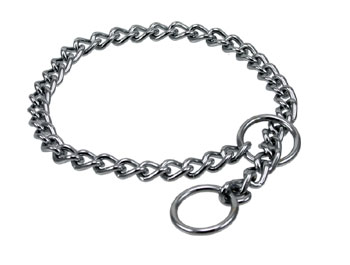
The Slip Collar is most commonly known as the Choke Chain. The Slip Collar is a steel chain with a large ring at each end. To use the collar you pull the chain through one of the rings then slide it over the dog's head. The Slip Collar should go over the dog's head without any force. A slip collar should only be worn during training.
This training tool uses negative reinforcement and positive punishment. Although the slip collar can quickly suppress unwanted behavior, it can easily be used incorrectly. Improper use can lead to sever neck damage and possible strangulation.
I do not recommend using a Choke Chain when training your dog. Again, look into a head collar or easy-walk harness instead.

This training tool uses negative reinforcement and positive punishment. Although the slip collar can quickly suppress unwanted behavior, it can easily be used incorrectly. Improper use can lead to sever neck damage and possible strangulation.
I do not recommend using a Choke Chain when training your dog. Again, look into a head collar or easy-walk harness instead.
Tuesday, April 20, 2010
Do I have TIME for a dog?
Having a dog for life is a commitment. Dogs take a lot of time and energy to train properly. If you really want to have the perfect dog, you have to work for it.
When considering to adopt its important to take a good look at your daily schedule. Dogs require a minimum of TWO walks per day, and yes EVERY DAY! It is important that each walk is a minimum of 30 minutes, and should be closer to an hour. Keep in mind that many high-energy dogs will require longer walks.
Besides walking your dog twice a day, you will need time to train him/her in basic obedience and other skills. It's also important to have play time a few times throughout the day.
Realistically, you should consider that you will be doing DOG TIME about 3 hours per day. This of course will vary by your dog's energy level and age. Younger dogs need more exercise because they have lots more energy. Once you get your dog into an exercise routine, less time may be required. Also consider time for love, cuddling, and petting.
If you're really seriously considering adopting a dog, talk to your friends with dogs, walk your neighbor's dog a few times, and visit your local shelters (BEFORE you're ready to adopt).
Really think about if you have the appropriate amount of time before bringing a new member into your family.
When considering to adopt its important to take a good look at your daily schedule. Dogs require a minimum of TWO walks per day, and yes EVERY DAY! It is important that each walk is a minimum of 30 minutes, and should be closer to an hour. Keep in mind that many high-energy dogs will require longer walks.
Besides walking your dog twice a day, you will need time to train him/her in basic obedience and other skills. It's also important to have play time a few times throughout the day.
Realistically, you should consider that you will be doing DOG TIME about 3 hours per day. This of course will vary by your dog's energy level and age. Younger dogs need more exercise because they have lots more energy. Once you get your dog into an exercise routine, less time may be required. Also consider time for love, cuddling, and petting.
If you're really seriously considering adopting a dog, talk to your friends with dogs, walk your neighbor's dog a few times, and visit your local shelters (BEFORE you're ready to adopt).
Really think about if you have the appropriate amount of time before bringing a new member into your family.
Friday, April 2, 2010
Breed of the Month--Lhasa Apso

Lhasa Apso
Color: Any combination of black, white, brown, sandy, slate, smoke, honey, golden, dark and grizzle.
Height: Males: 10-11.5 inches/ Females: slightly smaller
Weight: 13-18 lbs
Life Span: up to 18 years.
Breed Health Concerns: renal dysplasia and progressive retinal atrophy.
Coat: Both a dense outer and innercoat.
Country of Origin: Tibet (China).
Visit the American Kennel Club for breed standards and more information.
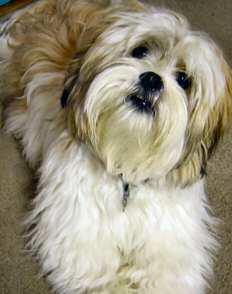
Shaggy, small dogs have been known of as far back as 8000 BCE. Believed to bring prosperity and peace, these small dogs were widely given as gifts. Buddhism encouraged the breed's look of a lion, the symbol that represents the power of the Tibetan Buddha.
Lhasa Apsos can easily distinguish friend from foe and have served as highly regarded companions. Lhasa Apsos can become possessive if not properly socialized from a young age.
Exercise:
Although small, the Lhasa Apso is very sturdy and requires plenty of regular exercise. The Lhasa Apso will insist on being part of the daily action and family activity.
Grooming:
Show ring Lhasa Apsos require daily grooming. The family pet should be brushed regularly and extra care must be taken to make sure the eye area stays clean.
Training:
Lhasa Apsos have been spoiled dogs for centuries and can make training more of a challenge. Because they are devoted, the can be quick learners when properly motivated. Socialization is critical for the Lhasa Apso.


Monday, March 22, 2010
Prong & Pinch Collars
The standard prong collar has blunt prongs designed to pinch the dog. When giving a dog a correction using this collar, the interlocking metal links constrict, causing the prongs to pinch the dog's skin. This collar is designed to suppress unwanted behavior by immediately causing discomfort to the dog. To properly use this collar it must be fitted high up on the dog's neck, which most people don't realize.
I used to think this product was magical and used it on my dogs. I soon learned that these collars are not a nice way to train your dog. Positive reinforcement training does not use prong/pinch collars. Using these collars is training your dog with punishment.
If you have a dog that does not walk well on leash and you need help, please do NOT get a prong collar. Try an Easy-walk harness or head collar instead.
Using a prong/pinch collar on an aggressive dog can actually increase the aggressive problem. These collars can easily be painful to the dog when misused. Owners who misuse these collars can also cause a collapsed windpipe and damage to the dog's neck.

I used to think this product was magical and used it on my dogs. I soon learned that these collars are not a nice way to train your dog. Positive reinforcement training does not use prong/pinch collars. Using these collars is training your dog with punishment.
If you have a dog that does not walk well on leash and you need help, please do NOT get a prong collar. Try an Easy-walk harness or head collar instead.
Using a prong/pinch collar on an aggressive dog can actually increase the aggressive problem. These collars can easily be painful to the dog when misused. Owners who misuse these collars can also cause a collapsed windpipe and damage to the dog's neck.

Tuesday, March 2, 2010
Breed of the Month--German Shorthaired Pointer

German Shorthaired Pointer
Color: Liver, liver and white spotted, liver and white ticked, liver roan, may have markings of tan.
Height: Males: 23-26 inches/ Females: 21-25 inches
Weight: Males: 55-70 lbs/ Females: 45-60 lbs
Life Span: 12-15 years
Breed Health Concerns: epilepsy, hip dysplasia, bloat, von Willebrand disease, and eye problems.
Coat: Short, dense undercoat, with a short, dense, rough, hard outer coat.
Country of Origin: Germany
Visit the American Kennel Club for breed standards and more information.
Germans used many types of bird dogs for hunting as far back as the 1700s. By combining several types of tracking and pointing dogs, a new breed of versatile gun dogs began emerging by the 1800s. The German Shorthaired Pointer is believed to be a combination of English pointers and the German Bird Dog. Additions to the bloodline over time helped make the breed into a dog that would excel at water work, tracking, and retrieving.
The German Shorthaired Pointer is very excited and enthusiastic about most anything. Whether its hunting, going for a walk, or just hanging out with his family, the GSP is happy to follow. The GSP is great with children, but has an intensely high energy level.
Exercise
The more exercise the German Shorthaired Pointer can get, the better. The GSP needs to run. To help drain this breed's energy, many owners join some sort of activity such as: agility, obedience, hunting, or flyball.
Grooming
The GSP's coat requires very little care to keep it looking nice. This breed loves water and the many swimming escapades will require frequent bathing. Take special care to keep the GSP's ears clean and free from infection.
Training
The German Shorthaired Pointer is very people oriented and eager to please, making the breed fairly easy to train. Combine this breed's training with high value rewards like running, and use brief but positive training sessions to keep his attention and get the best results possible.


Subscribe to:
Posts (Atom)