Showing posts with label Watch me. Show all posts

Saturday, March 28, 2015

BML2--Class #2

Heel:
The Heel position is about the dog staying close to the handler and paying close attention.  We will start with the Basic Heel position, the Stationary Heel.
To do this, we will food lure the dog into the Heel position at our left side.  Use your left hand to food lure the dog into the position.  If you need, take a step back with your left leg to encourage the dog to move.  Once the dog is in the Heel position, practice a Sit and Look. 


Moving Heel:  
  1. Food lure the dog several times while backing up.
  2. Food lure the dog, now turn your body so the dog is now on the left side in Heel position (use the treat in your left hand).
—Always begin and end every Heel exercise with a Sit in the Heel position.
—When you stop moving forward, move your baited hand UP slightly to initiate the Sit position.
—As you are moving forward, the treat should be held up slightly from the dog so she is looking for it.  Gradually progress to moving your hand all the way up to the Look position.  

Come When Called:
(Puppy Ping Pong and Hide & Seek Games)

The Rules:
  1. Safety first.  Always have a leash or be in an enclosed area.
  2. When you say come, you have to see it happen.
  3. NEVER punish a dog for coming to you.


The Steps:
  1. Say the dog’s name and Come, one time only.
  2. Have a party.
  3. Lure (or gently lead) the dog back to you.

Remember, each cue/command has three parts to build up or work on:  
  1. Duration (Time)
  2. Distance
  3. Distractions

To improve the Cue:  we will apply a Reward Grading Scale.  
This means that you must know what your dog likes best.  For this scale, we will reward with a low level treat for an okay recall.  As the dog improves on speed and direction, the training grade is higher, and therefore the reward should be greater.  Once the dog runs the distance quickly and directly to you, use a Jackpot Reward.  This means giving the dog several treats quickly after performing a behavior exceptionally well.

Practice Come when Called while adding Distance.  
We will start at a distance where we know the dog will currently respond to Come, then slowly start adding distance each time.  If the dog does not do well, take the training back a step (move closer to the dog).  Remember to progress slowly.  Be sure to attach your long line dog leash for this training.  For this, it is helpful to have two people for each dog.  This will make this exercise much easier to practice.  (Puppy Ping Pong Game).  Remember to practice all 3 Steps of Come When Called each time (as needed).  

Come when Called while adding Distractions.
Next we will try adding distractions to Come when Called.  To begin, we will start at a lower distance then was just practiced.  Keep your long ling training leash attached.  Now we will practice Come when Called while adding distractions.  For this we will use other dogs and people from class, as well as objects to try and distract your dog during the Come command.  Be sure to take this training very slowly.  Heavily reward your dog for ignoring the distraction(s) and coming to you.  Slowly add more difficult distractions.  Remember to use your Reward Grading Scale.  For better recalls, reward more lavishly with better treats.

Practice Look, Sit, Down, & Stand:
Finally we will practice some Basic Manners.  Practice each cue and make the dog hold the position longer before the reward.  Be sure to say your Reward Marker, “Good,” the instant the dog performs the behavior, but withhold the treat for a few seconds.  Make the dog wait longer and longer for the reward.  When rewarding, praise lavishly.

Practice Stay:

For Week 3 class we will be adding Distance and Distractions to the Stay cue.  So for this week, practice the Stay cue without distance and distractions.  Simply work on building up Duration, or time.

Saturday, February 7, 2015

BML1--Class #3

Basic Manners -- Level One, Class #3

Maybe & Lillinoe playing before class.


Such Good Dogs Basic Manners Class #3

Review of what is Rewarding to Dogs:
1.  Voice
2.  Eye Contact
3.  Touch


Anti-Jumping/ Auto-Sit:
We want a dog to learn that anytime someone comes over, the dog should put their butt on the ground.  To practice, you basically walk up to your dog like an excited, random stranger, if the dog remains with All 4 Paws on the Floor, give your “Good” and reward.  If the dog jumps up, say nothing and walk away.

4 on the Floor:  When a dog can be greeted and keep all 4 paws on the floor and/or sit, reward the dog with a “Good” and soft, calm pet.  This is a good exercise to practice giving “Real Life Rewards.”  Always make your dog EARN what they get.


Practice Look / Watch Me:
We want a dog who looks to us for direction and permission.  Having a dog that is well focused on the owner will give you control over many situations.  This is the exercise you will practice when your dog becomes distracted during training.  This is meant to help focus (or re-focus) the dog back to the owner.
To do this, we place the treat directly in the dog’s nose then raise it straight up next to our eye, while standing back up.  As you raise your hand give your command word, “Look.”  Eventually we want the dog to look directly in our eyes, but to begin with, it they look anywhere in the general area of your head, say your “Good” and give the treat.
If your dog remains in position but is not looking at you, do NOT repeat your arm movements or verbal command.  Instead, hold the treat in position next to your eye while looking at the dog and WAIT.  You will wait 30 seconds to a minute.  If the dog still has not looked, give your No Reward Marker or “Uh-oh,” move positions, take a breath, and then try again.


Sit, Down, & Up:
We use the Food Lure technique to first teach these commands.  Some of these things may have already been learned, that’s great.  You can use the dog’s current knowledge of each cue and progress further to adding hand signals.  Each command should have its own word and hand signal.  (Demonstrated in training.)


Come when Called:
We now add all 3 Steps to Come when Called.
1.  Say the dog’s name, and Come.  ONE TIME ONLY.
2.  Have a party.
3.  Lure the dog back to you.
The reason we have 3 steps is, we start with step one, if that doesn’t work, we try step 2, if that doesn’t work, we go to step 3.  Properly practicing the steps and following the rules to Come when Called will help you build a reliable recall.  This is one of the most important things you can teach your dog.  As your dog improves, you must practice by slowly increasing distance, then adding distractions.  
(Command & Hand Signal demonstrated in training).


Impulse Control:
Teaching a dog how to control his natural impulses can be very helpful in our everyday lives.  Controlling your dog’s impulses can help keep him safe.  For example, you do not want your dog to run out into the road after a rabbit or squirrel and get hit by a car.  This is pre-training for teaching the Leave-It command.

In this exercise, we ultimately want the dog to look back to us for guidance when he is unable to get to the treat.  We are looking for the dog to control his impulse to snatch something off the ground.
To begin, hold the dog’s leash short and toss a treat just out of the dog’s reach.  Make sure the dog sees you do this.  The dog will tug and pull and possible claw trying to get to the treat.  When the dog looks away from the treat, reward the dog with a different treat (from your hand).  Pick up the treat you tossed, and start again.  The goal is first to get the dog to look away from the treat, and then to look back at you.  When the dog does this, give your “Good” and reward with a different treat.  Once the dog actually turns away from the thrown treat and LOOKS at you, give a very happy “Good!” with extra treats and praise.
Also check out our Impulse Control Training Video.

Koa practicing Impulse Control.

Devo & Ogi practicing Loose Leash Walking.

Loose Leash Walking.


PRACTICE!
Sit & Auto-sit, Down, and Up
Come when Called, with all 3 steps
Impulse Control


Ogi waiting for her reward for doing well.


Monday, February 2, 2015

VIDEO: Teaching a "Look/ Watch Me" to your dog

Below is a video taken from this month's Basic Manners--Level One Class.  In this video, Animal Behavior Certified Dog Trainer, Athena Angelic, explains and demonstrates how to begin teaching this Cue/Command to your dog.  We have also attached the notes for training for reference.


Look / Watch Me:
We want a dog who looks to us for direction and permission.  Having a dog that is well focused on the owner will give you control over many situations.  This is the exercise you will practice when your dog becomes distracted during training.  This is meant to help focus (or re-focus) the dog back to the owner.

To do this, we place the treat directly in the dog’s nose then raise it straight up next to our eye, while standing back up.  As you raise your hand give your command word, “Look.”  Eventually we want the dog to look directly in our eyes, but to begin with, it they look anywhere in the general area of your head, say your “Good” (Reward Marker) and give the treat.

If your dog remains in position but is not looking at you, do NOT repeat your arm movements or verbal command.  Instead, hold the treat in position next to your eye while looking at the dog and WAIT.  You will wait 30 seconds to a minute.  If the dog still has not looked, give your No Reward Marker or “Uh-oh,” move positions, take a breath, and then try again.


Marker Word:
Use your chosen marker word:  “Good” or “Yes” (or the Clicker).
This is the word (or sound) that says to a dog, “Yes! That is exactly what I wanted you to do!” and is then followed with a reward.

No Reward Marker:
This is what we do when the dog does not do what we are looking for.  Try using an “Uh-oh” or “Eh-eh.”  This will let the dog know that the behavior just performed is not what we wanted, while still encouraging the dog to continue to try.  After using the NRM, physically move places (both you and the dog should move) to help “re-set” the training, then try again.  Never repeat a command more than once.

Saturday, January 31, 2015

BML1--Class #2

Basic Manners -- Level One, Class #2


Such Good Dogs Basic Manners Class #2

Commands & Cues:
All commands or cue words like Sit and Come should be said ONE TIME and ONE TIME ONLY.  Never repeat your command word.  Instead give your No Reward Marker, move positions, and then try again.

Marker Word:
Use your chosen marker word:  “Good” or “Yes” (or the Clicker).
This is the word (or sound) that says to a dog, “Yes! That is exactly what I wanted you to do!” and is then followed with a reward.

No Reward Marker:
This is what we do when the dog does not do what we are looking for.  Try using an “Uh-oh” or “Eh-eh.”  This will let the dog know that the behavior just performed is not what we wanted, while still encouraging the dog to continue to try.  After using the NRM, physically move places (both you and the dog should move) to help “re-set” the training, then try again.  Never repeat a command more than once.

Food Lure:
This is something we use to teach many new behaviors and commands.  A food lure involves getting the dog to follow your baited hand into a desired position.

Look / Watch Me:
We want a dog who looks to us for direction and permission.  Having a dog that is well focused on the owner will give you control over many situations.  This is the exercise you will practice when your dog becomes distracted during training.  This is meant to help focus (or re-focus) the dog back to the owner.
To do this, we place the treat directly in the dog’s nose then raise it straight up next to our eye, while standing back up.  As you raise your hand give your command word, “Look.”  Eventually we want the dog to look directly in our eyes, but to begin with, it they look anywhere in the general area of your head, say your “Good” and give the treat.
If your dog remains in position but is not looking at you, do NOT repeat your arm movements or verbal command.  Instead, hold the treat in position next to your eye while looking at the dog and WAIT.  You will wait 30 seconds to a minute.  If the dog still has not looked, give your No Reward Marker or “Uh-oh,” move positions, take a breath, and then try again.

Watch a VIDEO teaching the "Look/ Watch Me" Cue in Basic Manners dog training class.


Come when Called:
The Rules:
1.  Always have a leash (or fenced-in area).
2.  When you say come, you have to see it happen.
3.  NEVER punish a dog for coming to you.

The Steps:
  1. Say the dog’s name, and Come.  ONE TIME ONLY.
  2. Have a party.
  3. Lure the dog back to you.

When first teaching a dog Come when called, we start with step 1 & 3.  Standing directly in front of the dog (No distance), put the treat in the dog’s nose, say the dog’s name and Come (one time), then quickly back up a few steps.  When the dog follows, stop, say “Good!” and give the treat.  (Explained & Demonstrated in training.)


Loose Leash Walking:
Loose leash walking (LLW) means that a dog walks nicely, not pulling on the leash, and not completely all over the place.  LLW is not the same thing as Heel.  To teach a proper Heel, you must first teach LLW.

Consistency is very important when teaching LLW.  Doing this technique is actually very easy, but does require a LOT of patience.  Remember to stay calm.  If you are calm and consistent, your dog will be walking nicely on a leash in about a week.

To begin, go out for a walk with your regular 4-6 foot leash and buckle collar properly fitted to your dog’s neck (so they can’t slip out).  As soon as there is tension on the leash, you have two options:
When the dog pulls:  1)  Stop and wait for the DOG to move in a way that releases the tension.  When s/he does, continue walking.
2)  Say “Let’s Go!” and walk off in the opposite direction.

It is best to try and do option #1 as much as possible.  Be sure that when you stop and wait, you do not move in a way that is releasing the tension on the leash…the dog must do it.
REMEMBER:  Patience!  Patience!  Patience!


Meeting new friends.

Boone, Koa, & Maybe...these three are excited to play!


Tuesday, June 17, 2014

Animal Behavior College Mentor Training--Part Two


As a graduate of Animal Behavior College (ABC), I was very excited when they asked me to be apart of their mentor training program.  As part of the program to become a dog trainer, ABC requires both book knowledge and hands-on training.  The latter is where I come in.

(First see Animal Behavior College Mentor Training--Part One)

PART TWO:

Class may be over, but my Mentee also accompanied me on several private training appointments.  During these appointments Jess was required to watch, participate, and eventually help teach.

For this private lesson, Jess was asked to go over the Leave-It command with Melissa and her dog Lucky.  Melissa has been training with Such Good Dogs with her two dogs Lucky and Hazel.  In this lesson we focused on just Lucky.  Since Hazel has come into the picture (about a year ago), some of Lucky's bad behaviors have gotten worse.  One thing we have been working on is Lucky's aggression towards men.  With the addition of the new dog came a power struggle in the house.  Although Melissa is doing amazingly better about being a good pack leader, there are still things to work on.  One helpful command to practice is the Leave-It.  When properly taught, this command can be used to tell your dog to leave anything alone, from people to other dogs, or even small animals and random trash.  Properly teaching a good Leave-It command can help keep yourself, your pet, and everyone else safe.  

You will notice that Jess seems much more confident and calm.  She is standing close to the dog while still remaining upright, and her overall body language has improved.  Also notice the close attention the dog is paying to her.  This is something we have been working on improving with the owner.  I am very proud to see Jess jump right in and take command over this dog.  She is projecting a calm and confident energy.  Doing this during training will help you build a better bond with your dog, help your dog pay attention, and also encourage your dog to learn.  Seems simple right?  It is.  The problem comes because as humans our emotions are easily swayed.  Don't let that anger or frustration get the best of you.  Take a deep breath, calm down, then continue your training.
Finally Jess is asked to observe the client perform the Leave-It command she just demonstrated.  While watching the client, it is important for Jess to notice what she does right, but also where she could use improvement.  Jess was correct to remind the client to only repeat the command one time.  This is important for any cue or command you are teaching.  Say it ONE TIME, and ONE TIME ONLY.  Repeating a command only teaches a dog that maybe the 5th or 10th time I say it means do it.  Say your command one time only.  If the dog does not comply, wait 30 seconds, then give your "Uh-oh" (No Reward Marker), move positions (this helps re-set the training in the dog's mind), then try again.

In this picture, Jess works with Hazel (Melissa's other dog).  Hazel is young and very high-energy.  One of the issues Melissa has with Hazel is her need to want to chase after things when out on a walk.  She enjoys picking up anything from leaves and branches, to random trash and dead animals.  We will again use the Leave-it command to practice getting Hazel to leave things as they pass.  Jess assists by walking by Melissa and Hazel and dropping random plant objects.

Finally, Jess is asked to teach several basic manners commands.  In this first picture, Jess demonstrates to a client how to do a proper Look.  Here you can see the dog looking directly at Jess.  This is exactly what we want.  At this point, Jess will give her Reward Marker, "Good!" then treat.


Here Jess is teaching the same Look command.  Jess is observing the client performing the cue.  As you can see, the dog is looking at the owner, which is what we want to happen.  Again, the client will give their "Good," then reward.


Although Jessica successfully performed and taught all commands, I will not show all of them here.  Instead I will end with one of the most important things you can teach your dog, a reliable Come When Called.  This is something every owner should strive for.  After discussing the 3 Rules and 3 Steps to teaching a dog Come when Called, Jessica demonstrates with a game called Puppy Ping Pong.  For this game, you need 2 people and one dog.  Each person will take turns practicing calling the dog over.  After the dog successfully has performed the Come cue, the person will practice one or two other commands.  These can include:  look, sit, down, up, and any tricks your dog may know.  The point of this game is to reinforce the Come when Called, but it is also an easy and helpful way to add an auto-sit after a come when called.  First practice and reward the dog for performing the Come command, then immediately ask the dog to sit every time.  After several repetitions, the dog will automatically start to sit after they come to you. 

Overall my experience training an ABC student trainer was a pleasant one.  Although breaking my leg in the middle of our training definitely caused set-backs, we were still able to complete Jessica's training.  I'm very happy and proud to have been a part of this experience and I wish Jess all the luck and success in the future.  With a bit more practice and confidence, I believe Jessica has the potential to become a very good dog trainer.

A special thank you to Animal Behavior College for the opportunity.


Monday, June 16, 2014

Animal Behavior College Mentor Training--Part One


As a graduate of Animal Behavior College (ABC), I was very excited when they asked me to be apart of their mentor training program.  As part of the program to become a dog trainer, ABC requires both book knowledge and hands-on training.  The latter is where I come in.  So a few months ago, I got to meet my Mentee, Jessica.

PART ONE:

For the first part of her hands-on training, Jess brought her dog, Kaiko, to one of my Basic Manners Dog Training classes.  She took the class as any other client would.  Basic Manners is a 6-week, one hour per week class.  Each week the class learns new things to take home and practice with their dogs.  Handouts are given at the end of each week, and a certificate is given upon completion.  Items covered in the Basic Manners class include:  Come when called, Look/ Watch Me, Loose Leash Walking, Sit & Auto-sit, Down, Stand/ Up, Stay, Leave-it, and Drop-it.

During this class, Jess learned what it is like to be in a group class and take direction from an instructor.  Having participated in this class, Jess has learned not only how to better work with her own dog, but also got to see how a large training class is properly run.  A good instructor should be able to keep everyone under control and on-task.

First we must work on a student's technique in working with the dog.

These first few pictures are the first day Jess worked with her dog in class.  Remember, your body language when training a dog is very important.  You can see in these pictures that Jess is not only back too far from the dog, but is also arching her back outwards and away.  In the dog world, this makes you a weak energy.  To correct this problem, she should step in and stand straight up.  In this first picture, you will also notice the leash is tight.  You want your leash short but loose when working with your dog.


Always remember to stand tall and calm, but not stiff.  When working with your dog, stand directly in front of them.  There should be no more than 12-18 inches between you and your dog.  
In the second picture, you can see Jess is still standing too far away, but has loosened the leash.


One of the most important things students learn in Basic Manners Dog Training is Loose Leash Walking (LLW).  This basically means the dog is walking nicely on a leash, not pulling, and not all over the place.  (Also visit our Trainer Tips for more help).  To train a dog how to Loose Leash Walk, you basically have two options.  When the dog pulls you 1) stop and wait for the dog to move in a way that releases the tension on the leash, or 2) say "Let's go!" and walk off in the opposite direction.  Here you can see Jess demonstrating the stop and wait technique for LLW.  If you are consistent in teaching LLW to your dog, you will have a dog that is a pleasure to walk with in a short amount of time.  But remember to be consistent!  Letting your dog just pull every now and then sets back your training.

The first class with owners and their dogs can very hectic and stressful.  This is to be expected.  Many new dogs are coming together for the first time and can get easily over-excited.  People are also excited and sometimes nervous about what might happen.  As class progresses, a good trainer will make all students feel comfortable and welcome, while still helping them to improve their training techniques with their dog.  In these next pictures, if you look at the body language in both Jess and Kaiko, they seem slightly more relaxed.  Noticing little things like this is important.

This next picture is Jess working with her mom and Kaiko.  Part of being consistent is making sure that everyone in the household has all the same rules, all the same cue words, all the time.  Not being consistent with your dog confuses her, and sets back training.  I highly encourage families to have all member present during training.  It is important that everyone is on the same page when it comes to training.  If you have a large family, it may be helpful to keep a list of rules, cue words, and commands you use for everyone to see.  Practice training together.  Help each other.  Remember not to get frustrated.  Stay calm and make it fun.


As class progresses week by week, participants succeed in some areas and have trouble in others.  As a trainer, it is vitally important to help correct the weak parts, but also point out the things that people do well.  We do positive reinforcement training for both dog, and human.  Clients training their dogs must also be told when they do things well and encouraged to continue.  In this picture, you can see that Jess has gotten much closer when working with the dog, and has much better body language.


Sadly, 6 weeks goes by very fast and class is over.  Above are the graduates of Basic Manners Level One, April 2014.  Jess is on the left, with other class participants to the right.  Clients are always proud and excited to receive their certificates.


Continue reading Animal Behavior College Mentor Training--Part Two.


Monday, October 14, 2013

Basic Manners Class #2


I'm very excited to have started a new Basic Manners class on the West Side recently.  Although I always enjoy classes, having an especially large class can be extra fun.  This class has 7 dogs in it and everyone is very excited to be here.  I always love helping people who are ready and willing to put in the work.  Hopefully I will be able to see just how hard they've all been working at this week's class.

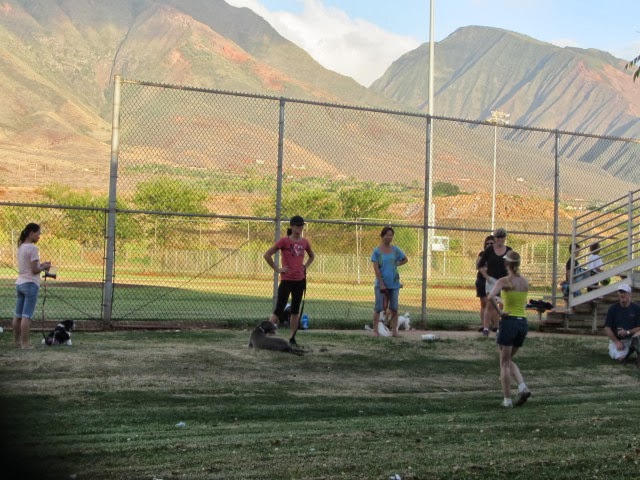
Below are some pictures from week two of this Basic Manners class.  This is the first time all the dogs get to meet each other, so the energy and excitement of week two is high.
(I was happy my friend was able to stop and take some awesome pictures for me as well.
Thanks Megs!)

Athena describing the first lesson for the day.

Class participants.

Athena working with Keani & mom Barbara
on Loose Leash Walking.

Athena working with Kengie & mom Sanchi.

Athena showing lab, Kuma, how to walk on a leash
with family watching how its done.

Kuma watching Mocha & Kengie say hello.

Hanging out after class.