Showing posts with label class 1. Show all posts

Saturday, March 21, 2015

BML2--Class #1

Basic Manners - Level Two:  Class #1
The first class is a review of all things learned in Basic Manners Level One...


3 Things on your body that are Rewarding to Dogs:
  1. Voice
  2. Eye Contact
  3. Touch

Anytime you engage your dog in one of these things, you are basically rewarding whatever behavior they are doing at that time.  This is important to keep in mind so we do not unintentionally reward bad behaviors.
You must catch a bad behavior within 2 seconds to change the behavior.

Marker Word:  “Good” or “Yes” or the clicker
This is what we say to mark the behavior we wanted.  Saying this is telling the dog, “that was exactly what I was looking for!”  The more you mark good behavior in a positive way, the more your dog will want to engage in good behavior.  

No Reward Marker:  “uh-oh” or “eh-eh”
This is to let the dog know that this is not what I was looking for you to do now.  We want to mark the behavior as not what we wanted, but we want to do so in a way that will still encourage the dog to want to learn.  When using an “uh-oh” while training, remember to take a step away from the dog to help “re-set” the brain, then try again.  Remember to only say cues ONE TIME, then wait 30 seconds to a minute before giving your “uh-oh” (give the dog a chance to make the right decision).

Basic Manners Review:
Look/ Watch Me:
We practice this command because we want a dog who looks to us for permission and direction.  Practice this cue both the simple way (directly from the dog’s nose up to your eye), and with the T position (start the same, then when the treat comes to your eye, move both arms out into a T position).

Come When Called:
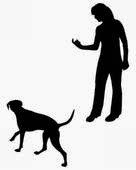
The Rules:
  1. Safety first.  Always have a leash or be in an enclosed area.
  2. When you say come, you have to see it happen.
  3. NEVER punish a dog for coming to you.
The Steps:
  1. Say the dog’s name and Come, one time only.
  2. Have a party.
  3. Lure (or gently lead) the dog back to you.


Loose Leash Walking:
When your dog pulls on the leash, you have two options…
  1. Stop and wait for the dog to move in a way that releases the tension of the leash.
  2. Say “let’s go” and go off promptly in the opposite direction.

Sit, Down, & Stand:
All these positions should already be well practiced.  Dogs should know the verbal and hand signals for each command.

Leave-It:
This should mean to a dog, turn away from that, don’t pay attention to that, leave that thing alone.  Remember that whatever you are asking your dog to Leave It, he should NOT get that item at the time you are practicing the Leave-It.  Never practice Leave-It/ Take-It (this can teach a dog to leave something alone for a second, then take it anyway).  We want our dogs to know that when I say to leave something alone, you don’t touch it ever.
Making Leave-It harder:  1. Treat in closed hand, 2. Treat in partially open hand, 
3. Treat in open hand, 4. Treat in open hand on the ground, 5. Treat on the ground.

Stay:
Means to your dog, stay in this position until I come back to release you.  This is not the same thing as Wait.  There are 3 parts to the Stay Cue:
  1. Duration (Time)
  2. Distance
  3. Distractions

Drop It/ Give:
When teaching this cue, we must be aware of possible Resource Guarding.  Remember to NEVER steal things from your dog’s mouth.  To teach Drop It/ Give:
Have the dog have a toy in his mouth that is not of super high value.  Once the dog has the toy and is engaged with it, present a treat or reward of higher value than the toy, as the dog drops the toy, say “Drop.”  It is very important to give the reward to the dog AT THE SAME TIME as you pick up the dropped toy.  Do not let your dog get into the habit of snatching the reward then snatching the toy back up.


For Week 2 class, please bring a long-line leash or long rope for distance work.  Also bring a squeaky toy that your dog loves.  This will be used to help the dog focus back on you during Distraction work.  As always, bring a variety of lots and lots of good treats that your dog loves.

Saturday, January 24, 2015

BML1--Class #1

Basic Manners -- Leve One, Class #1


It's a new year year and we have started another new Basic Manners Level One dog training class.  Therefore I have decided to share the information from these classes.

Each week we will share the notes and pictures from that class.

Basic Manners Level One is a 6-week, one hour per week class. Each week you will learn new things to take home and practice with your dog. Handouts will be given at the end of each week and a certificate is given upon completion. Basic Manners is taught using positive reinforcement training, combined with energy balance. Classes will be held outdoors in the Lahaina area.

Items covered in this Basic Manners--Level One dog training class include: Food lure, marker word, no reward marker, watch me/ look, come when called, loose leash walking, impulse control, sit and auto-sit, down, stand, stay, drop it, and leave it.

For the first week's class, clients do not bring their dogs.  I have considered changing this approach many times, however, I have found that it is much easier to get people to listen to the most important information without the distraction of their dogs around.  The first week of class, clients fill out paperwork, I ensure that the dog is up-to-date on all shots by checking vet records, and I give out the most important information on dog training.  

Below I have shared the notes given to each person for the first week's class.

Such Good Dogs Basic Manners Class #1

Dog training lessons are about training the HUMAN, and teaching the human how to communicate with the dog so we can motivate the dog to work and learn.  When a dog misbehaves it is really a breakdown in communication.  Dogs do what works for them, don’t assume they know better.

When training a dog of any age, you must start at the bottom and work your way up.  Basically, we are starting in Kindergarten.  Remember to move training at the dog’s pace, not your own.  Keep calm and do not do repetitions too many times.  It’s better to quit while you are ahead, than to push the training further than the dog is ready for.  The dog will lose interest and stop learning.

Such Good Dogs uses Positive Reinforcement Training.
Positive Reinforcement Training means making the dog work for something s/he likes.  We give the dog reinforcement at the moment the dog performs the desired behavior to increase the likelihood that the dog will perform the behavior again.  Dogs must WORK for everything they get.  Dogs should not get ANYTHING for free! (This includes:  toys, treats, regular food, water, sleeping arrangements, etc.)

Energy Balance
It is important to always be aware of what energy you are projecting anytime you interact with your dog.  It is vitally important to remain calm, but firm when teaching your dog new things.  Dogs will NOT follow or listen to a leader who is not calm.  If you are angry or frustrated, your dog will sense this, and your training session will not go well.

3 Things on our body that are Rewarding to Dogs:
1.  Voice
2.  Eye Contact
3.  Touch
Anytime you engage your dog in one of these things, you are rewarding them and encouraging whatever behavior they are currently doing.  This is important to keep in mind so you do not unintentionally reward bad behaviors.  Example:  when a dog jumps up to greet you, the proper thing to do is cross your arms and turn your back while saying nothing.

What do you do with behaviors your dog does that you do not like?
1.  Ignore
2.  Avoid
3.  Re-direct
It is important to manage your dog’s behavior in between training sessions.  You must help prevent bad behaviors from occurring.  Behaviors usually get worse before they get better.  You must catch a dog “in the act” within 2 seconds to change the behavior.

What motivates your dog?
To begin training, we first must know what motivates our dog.  Humans need motivation, so do dogs.  Would you go to work every day if you didn’t get paid?  Some common reinforcers for dogs include:  food, petting, toys, & praise.  You must also have a variety of rewards from “ok” to “really awesome.”  Your dog decides what 
s/he likes best  What is your dog’s Like It? Love It? Gotta Have It?

Marker Word:
Choose your marker word:  “Good” or “Yes” (or the Clicker).
This is the word (or sound) that says to a dog, “Yes! That is exactly what I wanted you to do!” and is then followed with a reward.  The more you mark the good behaviors, the more your dog will want to engage in these behaviors.  To “charge up” the Marker word, say your word, give a treat, repeat.  Example:  Say “Good”, give treat, Good, treat.

Things needed for Training:
Remember to have 2-4 different kinds of rewards on hand (several types of treats).  
Regular buckle collar and leash (easy-walk harness or gentle leader), NO Flexi-leash.
Water for both you and your dog.  Poop clean-up bags (ALWAYS pick up after your pet).
Most importantly, always bring a good sense of humor, LOTS of patience, and a calm energy.

Keep Training Going:
Proper Exercise:  Every dog should be walked every day!
Good Relationship with the owner:  When you get frustrated, remember why you got your dog, he’s your buddy, he’s your pal.  Don’t take set-back’s personal.

Socialization:  It is very important to have a dog that is comfortable in as many different situations as possible.  Take your dog everywhere you can, but proceed at your dog’s pace.
Consistency:  Everyone in the household should have all the same rules, all the same cue words and commands, ALL THE TIME!

Generalizing:  Dogs do not generalize well.  It is important to practice everything you learn, everywhere you go.
Training Sessions:  Keep them short and sweet.  3-5 minutes a few times a day.