Monday, October 1, 2012

Breed of the Month--Jack Russell Terrier


Jack Russell Terrier


Color:  White, with tan or black markings.
Height:  10-12 inches
Weight:  11-13 lbs (2 lbs for each 2 inches)
Life Span:  12-14 years


Breed Health Concerns:  patellar luxation, Legg-Calve-Perthes disease, cerebellar ataxia, myasthenia gravis, congenital deafness.


Coat:  Three types:  broken/ rough/ smooth, all weatherproof.
Country of Origin:  England

Visit the American Kennel Club for breed standards and more information.

The Parson John "Jack" Russell began breeding terriers in the 1800s for use in fox hunting.  Russell's terriers were bred to be bold yet restrained and became distinctively mostly white in color.  The breed standard favored by Russell was set by a group of terrier fanciers in 1904 in England.

Today the shorter-legged version of the breed is known as the Jack Russell Terrier, whereas the more squarely built, longer-legged dog is known as the Parson Russell Terrier.

Fearless and up for any challenge, the Jack Russell Terrier is ready to explore and accompany the family on any adventure.  A great companion, the Jack Russell Terrier is loving, sporty, eager, and frisky.  The breed can become quarrelsome with other people or animals when excited and must be properly socialized from puppyhood.

Exercise:
Alert and active, the Jack Russell Terrier is a high-energy breed that requires large amount of daily exercise.  Although small in stature, the occasional stroll up the block will not keep the Jack Russell satisfied.  Several brisk walks each day are required to keep this energetic breed happy and healthy.

Grooming:
All three coat types are easy to keep clean with regular weekly brushing.

Training:
Frequent but short training sessions are necessary to keep this independent minded breed focused.  Properly timed rewards during training are essential.  Proper socialization from puppyhood is important to this breed.


Friday, September 28, 2012

Wilma cat


Before leaving for our new life in Maui, Hawaii, I stayed with my dogs and my mom at my mother-in-law's house for about a week.  In the last week I finalized many things with such a big move happening.  I enjoyed spending my last days among family.

My mother-in-law has a cat, Wilma.  Although she had met our dogs briefly before, she had never spent such a long time with them.  This visit she was unable to just hide for the day.  My mother-in-law swore I would never be able to get the cat and dog together.  I love a challenge!!!

Nekita was raised as a puppy with cats and learned from an early age that you just don't mess with the cat.  They have claws, you leave them alone.  Nekita has since left every cat alone, given them their space, and always been very respectful of them.

Caravaggio, on the other hand, was raised as a puppy with an older cat, Brandy, that was fully declawed.  Brandy would paw Caravaggio in the face rapidly and repeatedly and he thought it was like some sort of face massage.  Although Caravaggio is okay around cats, he has the compelling urge to chase them.  He did apparently corner a stray in our fenced yard once.  My husband said he just ran back and forth, not knowing what to do next.  Caravaggio may like to chase cats, but he does not want to hurt or kill them...he wants to play with them.

So I accepted my mother-in-law's challenge to get her cat, Wilma, and Caravaggio to be friends.

This took me only a few days...

Caravaggio & Wilma relaxing together.


When we started the..."let's be friends," process, Wilma wasn't so excited about the idea.  The following pictures show the progress of Wilma's comfort level.  Training the cat to be comfortable with the dog was really just showing the cat that I controlled the dog, and that I would not allow the dog to harm her in any way.

If you look at Caravaggio's body position in this picture, you can see he is submitting to relaxing near the cat.  This lets the cat know that he means her no harm.

As Wilma gets a little more comfortable and playful with her catnip, 
Caravaggio can get a little closer.

Wilma made amazingly fast progress in her comfortability with that big pony/ dog.

Wilma got so comfortable she was able to get nose to nose.

Wilma was able to play next to the dogs.  
This is a HUGE step for a cat who was formerly terrified of dogs!

We're totally friends now!


Wednesday, September 19, 2012

Trainer Tips--Stinky Treats

Remember...when using treats in positive reinforcement training, they should be soft and stinky.  You want treats that are soft so that they are easily broken up into small pieces.  We can sometimes use a lot of treats during a short, one-hour training session, and we want to keep our pets healthy, so keep the pieces small.  Secondly, make sure you are using treats that are stinky.  Dogs like strong smelling, stinky treats.  The worse it smells to you, probably the better it smells to your dog.  You want a treat that the dog really likes and will work hard to get.

Remember...training treats should always be soft and stinky!


Here is an example of a good variety:
regular bacon dog treats, cheese, and turkey.
What works for your dog will depend on your dog's tastes.
Start with the low value (dog treat), and work your way up.
Always have a good variety of treats ready to try for your training session.

Treats should be cut into very small pieces.

Training treats should be smaller than the size of a dime.

Tuesday, September 4, 2012

Dogs in Art


So we decided to visit the Minneapolis Institute of Arts before leaving our state of Minnesota.  While looking through the art, we came across this sculpture.  My husband reminded me that dogs have been featured in art throughout history.  This is just one example.

"Love and Friendship," 1857, Bronze
Albert-Ernest Carrier-Belleuse


The dog looking lovingly at the woman in the sculpture.

Saturday, September 1, 2012

Breed of the Month--Bullmastiff


Bullmastiff


Color:  Must have black muzzle, can have white markings...red, brindle, fawn.
Height:  Males:  25-27 inches/  Females:  24-26 inches
Weight:  Males:  110-130 lbs/  Females:  90-120 lbs
Life Span:  8-10 years


Breed Health Concerns:  Allergies, cardiomyopathy, subaortic stenosis, mast cell tumors, bloat, elbow dysplasia, hemangiosarcoma, osteosarcoams, retinal atrophy.


Coat:  Dense, weather resistant, short, hard, lying flat to body.
Country of Origin:  Great Britain

Visit the American Kennel Club for breed standards and more information.

Created by crossing Bulldogs and English Mastiffs, the Bullmastiff was designed to be more agile and a quiet tracker, originally called "Gamekeeper's Night Dogs."  Poaching carried the penalty of death in England and Bullmastiffs were used to quietly bring them down.

The Bullmastiff of today is more mellow but still widely used for his amazing guarding abilities.  He is protective, but not aggressive.  The Bullmastiff is devoted to his family and alert, but is essentially a calm breed.  The Bullmastiff needs strong leadership and is not a breed recommended for first time dog owners.

Exercise:
Although the Bullmastiff is a very large dog, he does not require an enormous amount of exercise, and can sometimes be a bit lazy.  Regular twice daily walks will keep the Bullmastiff happy and healthy.

Grooming:
The coat of the Bullmastiff is easy to care for and needs only be brushed a few times a week.  Take extra special attention to keep the wrinkles of the face clean and free from infection.

Training:
The Bullmastiff grows large quite quickly and must be trained on basic manners from puppyhood.  Independent minded, the Bullmastiff needs consistent positive reinforcement training.  Socialization from puppyhood is also vital for the breed.


Tuesday, August 21, 2012

Akona Pet Travel

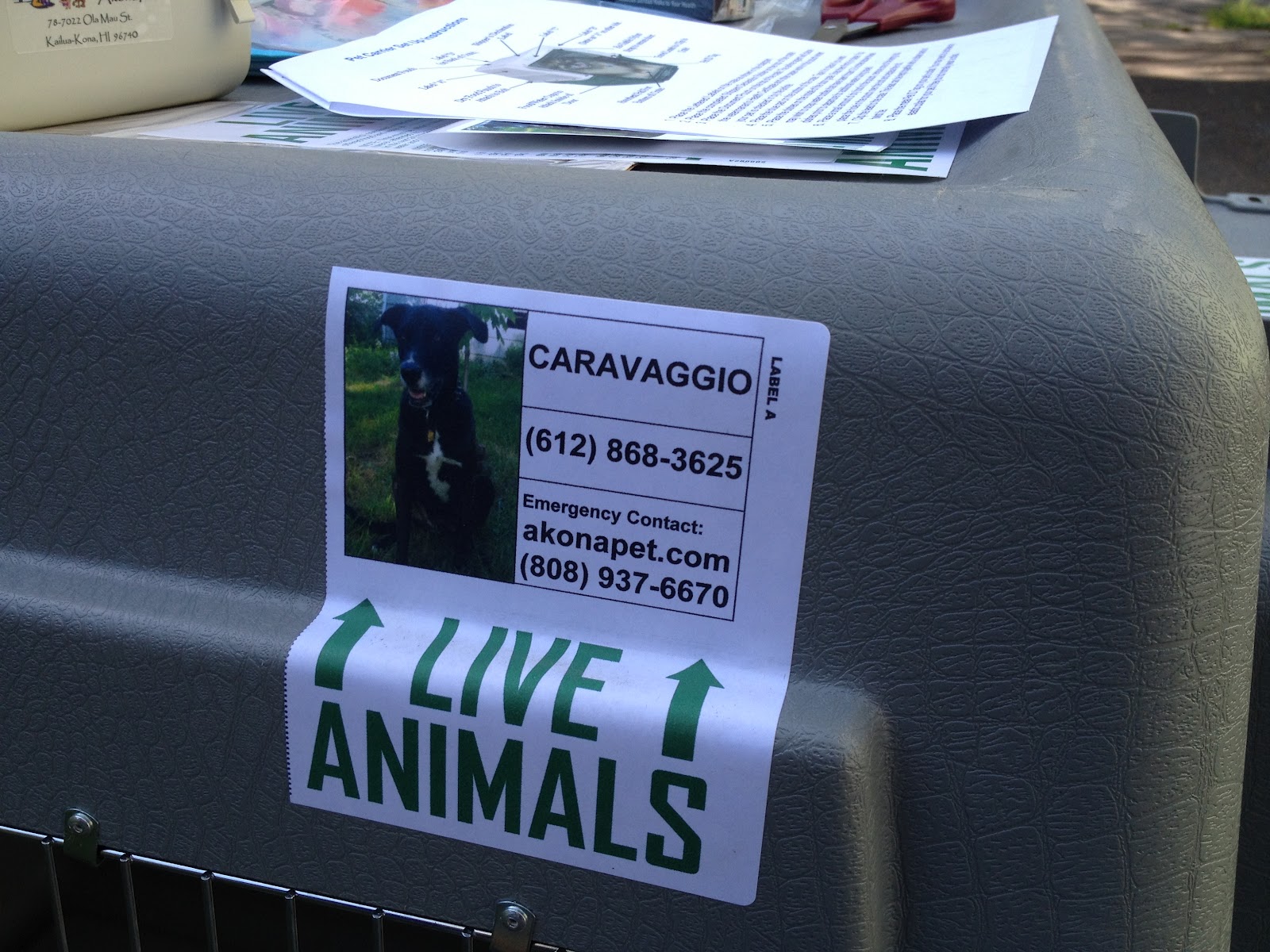
So after trying to understand the many rules envolved with flying dogs to Hawaii, we started to get a little frustrated.  The paper work and all the things needed for entering Hawaii itself we had under control (LOTS of paper work...lots!), but we were having a very difficult time actually booking the dog's flights to Hawaii.  Our younger dog, Caravaggio, is part Great Dane, and therefore insanely tall.  He was too big to fly.  How is that possible?  After trying to understand the many insane airline rules and regulations and extra paper work on top of all the other paperwork, it was just too overwhelming.  I'm very happy to say that we found a fabulous company to get through all the red tape for us, Akona Pet Travel.  

Today we received the dogs' Personal Akona Pet Passport Kits.  We're just 2 weeks away from flying the dogs, so I was happy to see them arrive.  Below are some pictures of the kits sent to us, and us applying the necessary items to one of our kennels.  


Follow the directions and start your stickering!

Caravaggio even gets his picture on his kennel.


Please be gentle with my pets.

Information sheet.

Documents pouch.

Bowls and leash.

They even gave us a lei for the pups!


Friday, August 17, 2012

Caravaggio & Nekita playing fetch

As one of the last things for us to enjoy with our dogs before our long journey to Maui, Hawaii, we took the dogs to the park near our house for some good old fashioned fetch.  Both our dogs love playing fetch, and as you can see, will play for as long as possible.  This video is our dogs doing one of their favorite games...fetch the tennis ball.

Keep in mind there should always be rules to games for your dogs.  As you can see from the video, our dogs must sit and focus (look us in the eyes) before being rewarded with another throw of the ball.


Monday, August 13, 2012

Basic Manners--Class #6


We had our last day of this block of Basic Manners Class.  The last Basic Manners class is all about reviewing everything we have learned (see Basic Manners Class #6--Notes post), and having a little fun.  We go over all cues and behaviors learned in class, practice them, and play some games (like Red Light/ Green Light with Loose Leash Walking.)  Here are some pictures from our last day of class.

Final day class participants

Lilly posing for a picture.

Red practicing come when called.

Red was adopted right before class started and became our most improved student!


Two 3-Legged Dogs


So our dog Nekita has been somewhat of a "gateway" dog for several of our friends.  Many people have fallen in love with Nekita's sweet disposition and then decide it is time for them to find a pup of their own.  Our friends, Aaron and Laura, are two of these people.  After they both fell in love with Nekita, they started looking on line for their first dog.  Laura actually ended up finding a dog on the internet that she fell in love with.  They actually drove all the way from Minnesota to Georgia to get their new dog.  The gray fluffy dog in the pictures below is their first dog, Ursa.

Ursa has something unusually about her...she only has three legs.  The shelter in Georgia where they got her was unsure of what had exactly happened, but Ursa ended up needing to have her leg amputated.  For a 3-leggeded dog, she can sure move pretty quick.

One day while they were walking Ursa in the local park, they came across a pet adoption fair.  They stopped to talk to a lady that was holding a cute little pit bull that was up for adoption.  After telling the adoption lady their story of how they adopted Ursa, the lady put the little pit on the ground.  Surprise, surprise this dog only had 3 legs as well.  What's more crazy?  The pit puppy was missing the same leg as Ursa.  They decided it was fate, and adopted their second dog.

So these are our friend's two 3-legged dogs, Ursa and Yoshi.

Ursa

Yoshi & Caravaggio

Yoshi

Sunday, August 12, 2012

Basic Manners Class #6--Notes

Review of all cues learned, questions, and games.

REVIEW:
Marker words
3 things on your body that are rewarding to dogs
Food Lure
Watch Me/ Look
Come when called
  -3 rules
  -3 steps
Loose Leash Walking
Sit
Down
Stand
Impulse Control
Leave It
Stay
Drop It/ Give

QUESTIONS:
Questions from participants.
Answers and further demonstrations.

Money saving tips:
Roll your own poop bags.
Left over human food.

Reminders:
Remember to be consistent in your training.  Be sure that all family members are using the same cues for each behavior.  Remember that every member of your team must learn to be a leader to your dog.