Wednesday, February 5, 2014

Trainer Tips--What do your dogs really want to do?

As a trainer, I am familiar with all kinds of dog questions.  One of my favorites is, "what does my dog want to do?"  As in, if my dog could do anything, what would it be?

Your dog wants to run and play, but also wants to be with you.  Dogs enjoy the experience of traveling with the pack.  The best form of exercise for your dog is a well-balanced pack hike.  Notice the way I worded that sentence.  There is a very large difference between a hike where your dog runs wild, and a well-balanced/ organized hike.  You want to be organized, but not overly-so.  Basically, a dog should earn everything from you as the owner, including the right to be let off leash while on a hike.  If you do not trust your dog or cannot control your dog, they have NOT earned the right to be off leash.  In that case, your dog should be secured to a long line (a 20-30 foot leash).  Do NOT use an extend-leash.  The extend-leash always has tension on the line, and encourages the dog to pull.  While on a hike and lone line, your dog should NOT be pulling you.  The purpose of using a long line is to teach a dog how to be off-leash but stay within a certain distance of you.  If you allow your dog to pull on a long line, this lesson will never be learned.

A great pack hike is also fun (and good exercise) for the humans.  You get to see and explore some of the amazing sites Maui has to offer that are right in your backyard.
One of the amazing views from the Village Trails in Kapalua.

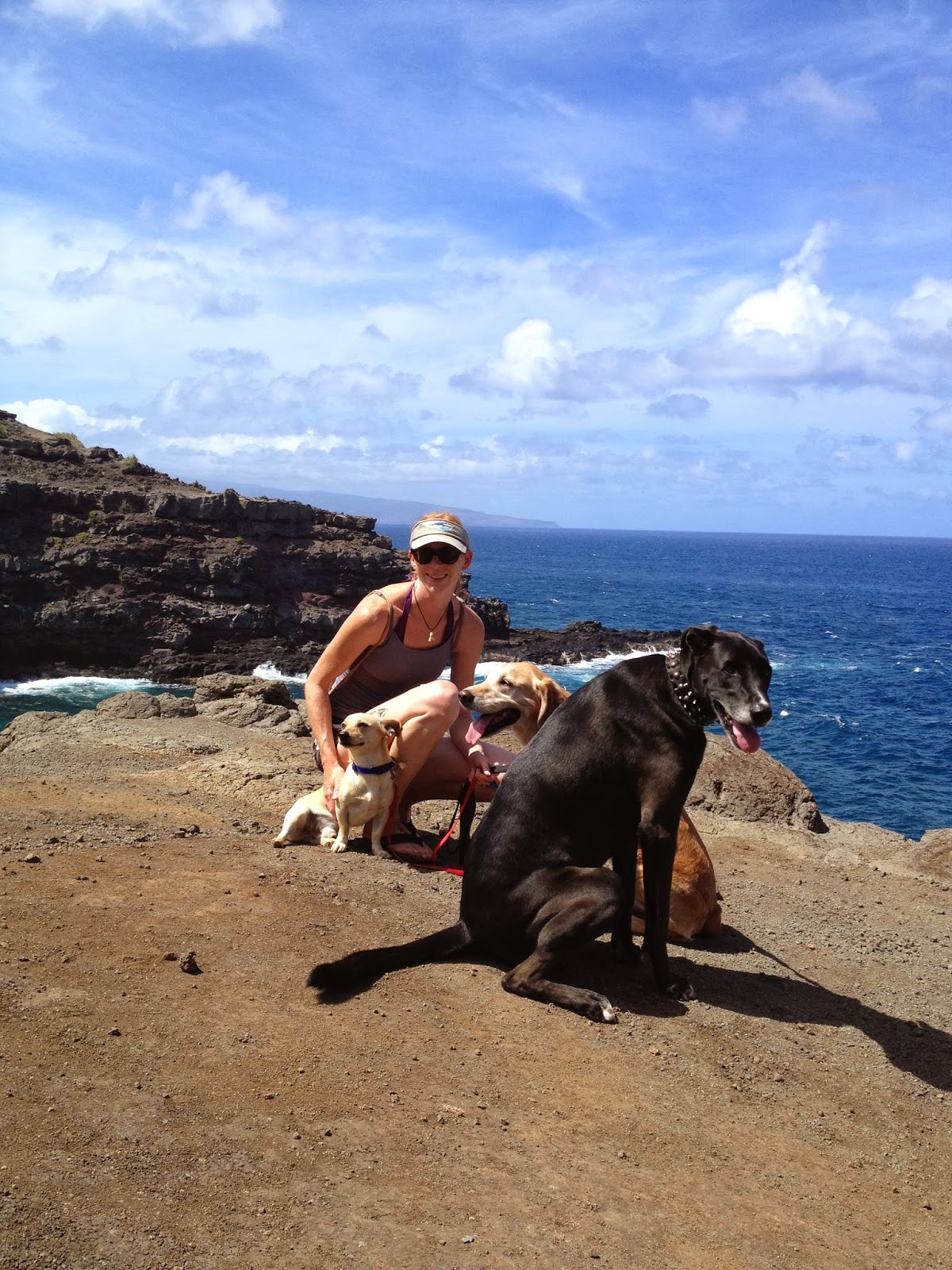
Athena with Toby, Nekita, & Caravaggio at Kapalua Coastal Trails.


Important things to remember when going on a pack hike...

Make them wait and calm down.
Before the dogs even get out of your car, they should be made to sit and wait.  My dogs are required to do this EVERY TIME.  The reason for this (and it's important) is because whatever the mind-set your dog is in when he is let out of the car, that is what he will take into that environment.  So if you let your dog out while they are crazy and bouncing all over the car, they will take that crazy into the outside environment.  This is a very difficult mind to control or even be heard by at all.  But, if you take the extra few minutes to make your dog sit and wait to be released until they have calmed down, they will go into the new environment much more relaxed and not be as apt to run off or offer other poor behaviors.


Make sure the pack gets along.
Go with someone (dogs) that your dog already knows and gets along with, or someone you know you can trust.  My dogs are well trained and familiar with how many dogs behave, good or bad, and know how to properly react.  I often use my own dogs to help train others.  The pack hike is one of my favorite activities to bring new dogs into, especially if they have issues dealing with other dogs or running away from the owner.  Using the Such Good Dogs pack is great because my dogs (and other dogs I have trained in the past I also use) know how the hike works and are obedient.  They will run through the field or woods or whatever, but come back to me and check in often.  They are not allowed and have learned to never wander too far away.  I will usually use a long-line (20-30 foot leash) for dogs that are new to the pack hike or particular area.  This ensures that this dog will follow the rules, because he is secured with a leash.  This keeps the new dog from straying too far from the pack.  Dogs who are off-leash have earned the right to be so.  Remember...Safety First!  If you don't trust your dog, have them secured to a long line.  If you don't trust someone else's dog, don't hike with them.


Good Exercise.
There is a difference between just plain physical exercise and mental activity.  Both of these things are very important for your dog.  Many times people like to just let their dogs run around crazy in their backyard or at the dog park.  Yes, your dog is getting some physical exercise, which is important, but they are doing so in a chaotic, undisciplined way.  It is much more important for your dog to engage in mental activity than just plain physical exercise.  Your dog will actually be more tired, and more satisfied with more mental challenges.  Furthermore, a dog who is more mentally focused is less likely to ignore their owner, and get into bad situations with other dogs.  The best way to protect your dog is to TRAIN HIM!

Below are some of the many pictures I have from various pack hikes.  You will see my dogs many times, as they are always a part of this type of dog training.

I love this picture.
Notice that the two further back are on leash,
they had not yet earned the right to be off leash.

Hiking near West Maui Kennels.

Lipoa Point.

We came across these two dogs while hiking the gulch. 

Lipoa Point.

The Village Trails.

The pond at the top of the Village Trails.


Amazing Maui and my dog(s).
One of my favorite things about some of these hikes is posing with my pack for some amazing Maui pictures.  This is a great goal for you to have and work towards.  Then you can proudly display some amazing pictures of you and your pet and show all your friends on the mainland how much fun you have together.  Below are some of my favorite amazing pictures with dogs.

Nekita at Honolua Bay.

Irie, Caravaggio, & Nekita

Beck at sunset.  Honolua Bay.

Athena with Toby at Kapalua Coastal Trail.

Athena with Nekita & Caravaggio near Honolua Bay.
I have a lot of these pictures (me and my 2 dogs).
This is my new favorite.


Wednesday, January 8, 2014

Trainer Tips--Holiday surprise pups


As we move into a new year, I like to remind people about some things we forgot during the busy holidays.  Today I would like to focus on people who received puppies or dogs as a Christmas or Holiday gift.  We hope that all these pups were given to someone who wants them, but that unfortunately is not always the case.

For those of you who did receive a holiday puppy and love you new pet, I am extremely happy for you.  Please remember to start training your puppy right away on basic manners and socialization.

On the flip side, this time of year is one where many times the shelter receives extra puppies and dogs that were given to someone over the holidays that did not want them.  It is very sad to think of, but it does happen.

So if you happen to be someone who was hoping for a holiday puppy and did NOT get one, it is the perfect time for you to go visit the shelter.  Keep your eyes open.  The shelter gets in new dogs and puppies for adoption all the time.  Once you have made the decision to get a dog, that does not mean you have to get it THAT DAY.  Take the time to prepare yourself and your household.  Never rush into adopting a dog.  Choose a dog that is right for you because he matches your energy and life-style, not just because he's the cutes puppy there the day you go for a visit.  Your dog should have the same or a lower energy level than yourself and family.

As always, please be responsible owners.  Teach your dog discipline and respect.  Teach your dog how he should properly behave in society.  Raise a dog you can be proud of.  If you need help, there are many other blogs within this site that offer different kinds of advice and training.  Of course, you can always give me a call and I can help you personally.

Above all else, please...don't let you puppy become this…

Wednesday, January 1, 2014

Lahaina Dog Training Class Starts January 3rd

Lahaina Dog Training Class starting soon…

Fridays 4:30-5:30 p.m.
January 3rd -- February 7th

This is a beginner class for dogs and their owners.  Dogs of all ages are welcome to join, provided they are up-to-date on Parvo and Distemper shots.  This is a 6-week class, one hour per week.  Each week you will learn something new to practice with your dog.  Basic Manners Dog Training is taught using positive reinforcement methods, combined with energy balance.

Cost for the class:  $150 CASH
Basic Manners Class includes:

*Marker Words
*No Reward Marker
*Come when called
*Watch Me/ Look
*Loose Leash Walking 
*Impulse Control 
*Sit & Auto-sit
*Down  
*Stand  
*Stay
*Drop It
*Leave It


If you are interested in the class, please contact us with:  your name, phone number, email, and name, age, and breed of your dog.
808-463-4684
suchgooddogs@gmail.com

Start your new year off the right way with a new positive outlook on life, and dog life.  Plus, everyone makes friends in dog training class.
(Kahiko & Dora, above left)


Berkeley & Sophie.

Splash & Eku.

Liko, Beau, & Hiccup.

These ladies actually switched dogs 
and loved each other's pups up after class one day.


Friday, December 6, 2013

Basic Manners Classes Starting Soon


Basic Manners Dog Training Classes 
Starting in January 2014
Lahaina, Kihei, & Kahului

This is a beginner class for dogs and their owners.  Dogs of all ages are welcome to join, provided they are up-to-date on Parvo and Distemper shots.  This is a 6-week class, one hour per week.  Each week you will learn something new to practice with your dog.  Basic Manners Dog Training is taught using positive reinforcement methods, combined with energy balance.

Cost for the class:  $150 CASH
Basic Manners Class includes:

*Marker Words
*No Reward Marker
*Come when called
*Watch Me/ Look
*Loose Leash Walking 
*Impulse Control 
*Sit & Auto-sit
*Down  
*Stand  
*Stay
*Drop It
*Leave It


Please contact Athena @808-463-4684 or email suchgooddogs@gmail.com to register.
Classes will be available Thursday or Friday, morning and afternoon.


Please let us know your name, phone number, email address, what day/ time works best for you, your location, & name, breed, and age of dog.


Athena Angelic, is an Animal Behavior Certified Dog Trainer, has been certified in pet first aid and CPR through the American Red Cross, and is a full member of the Association of Pet Dog Trainers.  Such Good Dogs specializes in training companion dogs, or family dogs, using positive reinforcement methods, combined with energy balance.  Such Good Dogs offers many different types of training programs, in-home dog boarding, dog adventures, and dog bootcamp.


suchgooddogs@gmail.com
808-463-4684


Sunday, December 1, 2013

Breed of the Month--Irish Setter

Irish Setter

Color:  Rich chestnut red with no trace of black, may have white markings.
Height:  Males:  23-27 inches/  Females:  21.5-25 inches
Weight:  Males:  70-75 lbs/  Females:  60-65 lbs
Life Span:  11-15 years

Breed Health Concerns:  Arthritis, canine leukocyte adhesion deficiency (CLAD), bloat, hip dysplasia, epilepsy, hypothyroidism, patent ductus arteriosus (PDA), osteosarcoma, progressive retinal atrophy (PRA), and von Willebrand disease.

Coat:  Straight, flat, with feathering, moderate length.
Country of Origin:  Ireland

Visit the American Kennel Club for breed standards and more information.
Also see our previous post on Sporting Breeds.

The exact origins of the Irish Setter are not known, but the breed is believed to be developed from pointers, setters, and spaniels.  These dogs have a highly developed sense of smell and were bred to locate birds and hold their position instead of chasing.  The unique abilities of this breed made it highly sought after in the 18th century for hunting and tracking.  The magnificent color of the dog's coat gained it popularity in the show ring in the 19th century.  The Irish Red Setter Club was formed in 1882 in Ireland.  The Irish Setter was brought to the United States in the late 1800s and the breeds popularity again grew.  A few years later, an overwhelming demand for Irish Setter puppies decreased its breed popularity.  US breeders took that opportunity to recover the breeds better traits and reemphasize its qualities as a field and show dog.

The Irish Setter is an intelligent, loving, and enthusiastic companion.  Admired by many for his beauty and grace, the Irish Setter has an upbeat happy-go-lucky personality and makes friends easily.


Exercise:
The Irish Setter is a very high energy breed and requires lots of daily exercise.  This breed needs at least two good hour long walks per day, plus plenty of other time to run, hunt, and explore.  This is a breed for a high energy, active person.  This breed excels at agility, obedience, hunting tests, and even pet therapy.

Grooming:
The beautiful red coat of the Irish Setter requires regular brushing.  Show dogs must be professional groomed.  Special care should be noted in taking care of his long ears that may become infected if not kept clean.

Training:
The Irish Setter is eager to please, but his enthusiasm can make long sessions difficult.  Short, positive, reward-based training sessions are recommended.  This breed is very intelligent but extra care must often be taken to keep his attention.


Wednesday, November 20, 2013

Trainer Tips--Barking Dogs

This month's Trainer Tip is being based on something that has touched us close to home recently…barking dogs.

As a dog trainer, a dog owner, and fellow neighbor, I would just like to say that a barking dog is NOT ACCEPTABLE!  That being said, let me elaborate…

Being in a neighborhood with lots of dogs, an apartment building with lots of dogs, and a dog owner myself, I fully understand that dogs can and will bark sometimes.  It is to be expected, it happens.  Many times owners do not know their dog has been barking if he only barks when they are away.  Other times, owners are fully aware and do not care.

To everyone I say this…HAVE RESPECT FOR YOUR NEIGHBORS.

Sure, we don't mind a little bark here and there, but there are limits to what is acceptable and what is not.

Acceptable Barking:
*If your dog barks once or twice when you first leave the house or come home, I would consider this acceptable.
*If your dog barks 2-3 times throughout the day for less than a minute.
*If your dog barks at someone that has knocked on your door or come onto your property (not just walking by on the sidewalk).

Unacceptable Barking:
*Allowing your dog to bark whenever, wherever, for whatever reason and as long as they feel like is absolutely unacceptable behavior, not only on the dog's part, but more so on the owner.  As the owner of your pets, you are 100% responsible for their actions.  Allowing your dog to continue to bark and bark is absolutely unacceptable and incredibly rude to the people around you.

*Getting defensive when a neighbor complains about your dog barking is not acceptable.  If a neighbor has taken the time to come and talk to you in a nice and respectful way about the disruption your dog's barking has caused, it is your responsibility to not only listen to their concerns, but to do something about it!
*If your dog repeatedly barks when let into the yard or tied outside.  If you know your dog is going to bark when you leave him outside alone, do NOT leave him outside alone.  Take the time to do some training and take responsibility for your barking dog.  The longer you let a dog engage in nuisance or boredom barking, the harder it will be to train them out of it.

*Excuses.  I'm sorry but there is absolutely no excuse for allowing your dog to continually bark and disrupt the people around you…NO EXCUSE!


Why do dogs bark?
Generally speaking, dogs bark and use other vocalizations to communicate, not only with each other, but with us.  It is our job as their owners to discover what they are trying to communicate.  Many barking problems stem from the dog trying to communicate something that the owner is not getting.

On-going/ Excessive Barking/ Nuisance Barking:
This is the type of barking that dogs build a habit of over long periods of time.  Most of this type of barking comes from lack of something else.  For example, lack of physical or mental activity, lack of socialization, or lack of leadership from the owner.  This type of barking will generally have a pattern to it; a similar series of barks that repeats over and over…and over…and over.  This type of barking is unacceptable and should be immediately addressed.


Barking as a Greeting/ Communication:
Often times dogs will bark at another dog or owner upon their return home as a way of saying hello.  Our dog, Caravaggio, does a sort of quiet howl/talking when we come home.  It's very cute.  This type of barking is acceptable in small doses.
(These 2 puppies are a good example of communication barking between dogs.)


Howling:
Some dogs will howl along with odd noises like a passing siren or strange high-pitched sounds (like in a song or on TV).  These random howls are acceptable.
Other dogs will howl when left alone.  This howl is generally a sign of distress in the dog, usually from being left alone.  Many dogs suffer from separation anxiety and this type of howling or the nuisance barking listed above can be symptoms of that.  Separation Anxiety can be a very difficult problem to deal with and should be addressed as soon as possible.


Separation Anxiety:
Some simple things you can do to help with separation anxiety include:

*exercise your pet before leaving (a tired dog is a good dog)
*give your pet plenty of things to keep him occupied (a Kong filled with yummy treats
and penut butter, a tasty bone, and/or several types of interactive toys)
*do not make a big deal about leaving and returning
(do not kiss your dog goodbye and tell him how much you will miss him,
this makes it harder for a dog with separation anxiety,
upon returning, ignore your dog until he calms down, 
then reward with calm love and praise.)
Dogs with separation anxiety often get themselves into trouble when left with nothing else to do.  That's why it is so important to do the things listed above, otherwise you may come home to a disaster (example above left).


Generally speaking, a dog that excessively barks is either exhibiting separation anxiety or boredom.  Either way, if your dog is excessively barking, it is your duty as the owner to take responsibility and take action to correct the problem.  Most barking problems can be solved with some simple training and exercise (both mental and physical).  But it is important to recognize exactly why your dog is excessively barking to determine the correct path.  Some dogs may bark to communicate some other problem they may be having, such as a physical (food, water, shelter) or emotional (excited, anxious, or nervous) need.  No matter the reason for the barking, something should be done about it.

Don't become the neighbor everyone hates because you can't control your dog's barking.  Take action!  Be responsible!  Train your dog to be a respectful member of your community.  Your neighbors will thank you for it!


Try this other SGDs blogs for more help:
Choosing an Anti-Bark dog collar.

Also check out an article by Victoria Stilwell, Barking.

Monday, November 4, 2013

Open enrollment for Dog Training Review


I will be opening my final class of the current Basic Manners dog training session for review.
Wednesday November 6th from 5-6p.m.

Anyone who has taken my Basic Manners Level One class or an equivalent in private lessons (or taken with another trainer) may attend.  If you are interested in possible future training and would like to see what a dog training class is like, observation is FREE.

There will be a $25 participation fee for the one hour review class.  You will be joining the current class on their last session and will be incorporated into the class.

Your dog should be familiar with the following to attend this review session:
Food lure
Look/ Watch Me
Sit
Down
Stand/ Up
Come when called
Loose Leash Walking
Stay
Drop It
Leave It

Your dog must be current on Distemper & Parvo shots.
(Please exercise your dog before the review hour.)
If you are interested in attending this review, please contact Such Good Dogs.
808-463-4684
suchgooddogs@gmail.com


Friday, November 1, 2013

Breed of the Month--Great Pyrenees


Great Pyrenees

Color:  White, white with gray, reddish-brown, badger, tan markings.
Height:  Males:  27-32 inches/  Females: 25-29.5 inches
Weight:  Males:  110 lbs minimum/ Females:  88 lbs minimum
Life Span:  10-12 years

Breed Health Concerns:  Bloat, hip dysplasia, degenerative myelopathy, elbow dysplasia, osteosarcoma, factor XI deficiency, progressive retinal atrophy, and skin problems.

Coat:  Double coat, weather-resistant.  Dense, woolly, ding undercoat.  Long, thick, flat outercoat.
Country of Origin:  France

Visit the American Kennel Club for breed standards or more information.

Separating Spain and France, the Pyrenees mountain inhabitants earn their living by tending flocks of sheep, cows, and other livestock.  Although the exact origin of the breed is unknown, the Great Pyrenees dogs have worked protecting livestock in this area for centuries.  This gentle giant is completely reliable with his flock or herd, and is ever sure-footed in the mountains.  Many Great Pyrenees pups are raised within their flock or herd from puppyhood.

The Great Pyrenees is devoted to his family, gentle, and trustworthy.  Bred to be suspicious of strangers, it is vitally important that this breed is properly socialized at a young age and throughout his life.  

I had the pleasure of having a Great Pyrenees neighbor.  She was one of the most gentle and loving dogs I have ever met and got along well with everyone, from adults to children, and other animals.  I feel blessed having known such a fabulous dog.

Exercise:
The breed's desire to patrol his territory may sometimes get the best of him; it is therefore important that the breed be kept on leash or in a fenced area during exercise.  Although the Great Pyrenees is a very large breed, he does not require excessive exercise.  Two to three good walks per day will satisfy his exercise needs.  It is most helpful to find some sort of "job" for this breed to do.  He will be well satisfied to guard the property or family.

Grooming:
The Great Pyrenees's coat will require almost daily brushing.  The coat was designed to protect this breed in all types of weather, and should never be shaved.  The hair around the toes should be occasionally trimmed and extra care must be taken to keep his face clean and wiped free of drool.  

Training:
If training the Great Pyrenees for guarding or herding, training will be easy.  In other aspects of training, the Great Pyrenees can be stubborn and requires a persistent and patient trainer.  This breed will not respond to harsh training methods.  Positive reinforcement training is best.


Monday, October 21, 2013

Trainer Tips--Dog Parks...Friend or Foe?

Dog Parks...Friend or Foe?


As a dog trainer, people often ask me many questions about training and different dog situations.  One that often gets asked is how I feel about dog parks.  In response to this question, I'm writing this month's Trainer Tips about dog parks.

If you're a fan of this blog, you know I often write about socialization and how important it is to properly socialize your dog.  Proper socialization does include introducing your dog to as many new situations, new people, and new dogs as possible.  However, all of these things should be done in a proper environment and at the dog's pace (see previous post).  Let me be perfectly clear, it is your job to be the leader in your home and elsewhere.  That means it is YOUR job to protect your dog from potentially dangerous situations and YOUR job to keep your dog from being the one that creates any such situation.  (See previous post on Leadership.)  Keep watch of other dogs and notice their Body Language to gage potential threats.

So how do dog parks fit in?

Generally speaking, I do NOT recommend taking your dog to a dog park on a regular basis.  The reason I say this is because dog parks are very chaotic environments with little or no rules.  Most people who bring their dogs to the park on a regular basis make the dog park the only regular exercise their dog gets, and generally have little to no control over their pet.  This is very bad!  A dog should actually be exercised BEFORE being taken to a dog park.  Why?  Well because when a dog is full of energy and excitement, they are more likely to engage in bad behaviors, especially if they are simply set free to do whatever they want in an chaotic environment with unstable dogs.  A huge part of my training program focuses on what I call Energy Balance.  If you have ever been to a dog park, you know that the energy and atmosphere of the park is chaotic and crazy.  This is NOT an environment I recommend.  Because the environment of the dog park is so chaotic, dogs can and will easily pick up bad behaviors. Further more, many dog owners that take their dogs to the dog park should NOT be around other dogs.

FOE!

There is an unofficial dog park in Honokowai that many people go to (including several friends and clients of mine).  I have also been to this dog park with my two dogs on a few occasions to check it out.    I DO NOT RECOMMEND THIS DOG PARK!  This dog park has had several instances of red flag warnings.  There is an owner that takes her dog to this park on a regular basis that should never be there.  Her dog has attacked at least two dogs that I know of, and bitten at least one owner when going for a third dog.  This owner picked up her little dog to get it away from the oncoming attack and the dog attacking jumped up and bit the woman's arm instead.  This woman had to have several stitches.  This same dog (who is not a very large dog) tried going after one of my dogs as well, Caravaggio.  Lucky for me, my dogs are both trained very well and will not engage in a fight unless absolutely necessary.  So this little attack dog kept lunging at Caravaggio for at least an hour one day.  Caravaggio did exactly what he was taught and moved away from the dog when it tried to attack and let me deal with the situation.  Funny enough I left the park with my two dogs for about 15 minutes and returned.  Upon our return this same dog came running and jumped up on my car trying to get at the dogs through the window.  Ridiculous!  The owner, of course, had no control.
This is just one example of a bad apple at the dog park.

Dora getting trampled at the Honokowai dog park.


There is also a high likelihood that your dog will pick up bad habits at a dog park.  Some examples of common bad behaviors dogs easily pick up at the dog park include:  barking, digging, toy possession, aggression, and not listening to the owner.  My best client and the dog I'm most proud of training is named Dora.  She is now about a year and a half.  I have been training with her and her owner since she was about 5 months old.  Dora and her owner made amazing progress and she has turned out to be a great dog.  However, about 6 months ago, her owner started taking her to the dog park mentioned above.  Since then Dora has picked up several bad habits that we must now address and train her out of.  She was also recently attacked (2 weeks ago), and received several puncture wounds on her back foot.
Here's a good example of a dog that should not be at the dog park.
As you can see, the owner has no control.


My other dog, Nekita, was also attacked at a dog park a few years back.  She was so severally attacked and injured at the time, that she became dog aggressive for a short while after the attack.  We had to put in some extra time and training to get her back to her usual self.

Another little-known danger is poison.  There have been various news reports over the last several years about people who do not like dogs leaving poison or toys laced with poison at dog parks.  I recently saw a story like this where a dog picked up a toy left at the dog park that someone had poisoned and passed away only an hour later.  People leave all kinds of toys at dog parks and most dogs will go up to a toy and pick it up without hesitation.  Although this danger is less likely to happen than others, it is still a possibility.

I do not share these things to scare you, but to make you realize just what you may be getting yourself into when attending a dog park.  This is not to say that all dog parks are bad all the time.  In fact I do believe that a dog park CAN be a fun place for you to socialize your dog.  The thing is, you have to really be aware of what's going on around you.  Don't become the owner that just brings your dog to the park every day and lets them do whatever they want!  If you are interested in attending a dog park, do your homework.  Go there without your dog once first at the busiest time (usually in the afternoon after work), and see what the environment is really like.  If you don't like what you see, don't return with your dog.  You can also try going to the dog park at less popular times.  At these times, the dog park will not only be safer for both you and your dog, but more conducive to training and socialization for your dog.

TRY A LESS BUSY TIME
Try the dog park when there is only one or two other dogs around.  This environment is much less hectic and better for your dog.  This will also allow you to easily assess the situation and meet other dogs and owners.  (Below:  Wicket & mom playing at the dog park at a quiet time.


FRIEND.


Overall, if you do end up taking your dog to a dog park, please be aware of what is going on around you.  Watch your dog at all times and keep them away from any potentially harmful dogs or situations.  Also beware of toys.  MANY dogs are possessive over toys, especially around large amounts of other dogs.  Two dogs going after the same toy can easily trigger a bad situation if one or both dogs are not properly trained and socialized.  The time Nekita got attacked in a dog park was because another dog wanted her ball.  When she got to the ball first, the other dog attacked her.  I have seen this same thing happen multiple times at the dog park.  Even if you don't bring your dog's toys, there is always someone who does.

The last reason I do not recommend dog parks is the lazy factor.  In my experience, most people who regularly bring their dogs to the dog park do so because they refuse to put any energy into exercising their dogs.  The best exercise for a dog is proper walk or hike.  And when I say proper, I mean walking on a leash properly, not pulling the owner everywhere.  The owner should be in charge of the walk or hike, NOT the dog.  A proper walk is the best exercise because the dog is not only getting the physical exercise they require, but mental activity as well.  A good owner will properly physically AND mentally exercise their dog.  Most people who bring their dogs to the dog park every day have not put in the time and effort to train their dogs on how to walk on a leash, and therefore take the lazy way out...the dog park.


TRY ANOTHER ACTIVITY!
There are so many activities we can do with our dogs, that I don't even need to take my dogs to such a place.  Go for a walk, go for a hike, go swimming, play fetch.  There are so many other forms of activities that are much healthier for both you and your dog.  So stop being the lazy owner that does nothing with your dog and get out on a new adventure!  You're dog will thank you!
Plus, its fun and even easier to make friends with other dogs at these activities!

Caravaggio, Dora, & Nekita swimming.

Kana & Nekita relaxing on the beach.

Kahiko & Dora hanging out after a hike.

Caravaggio & Jack at the beach playing fetch.


TAKE A TRAINING CLASS
Still need a way to make some new doggie friends?  A great way to meet new dogs and new owners is to take a dog training class or activity.  In every class I have taught, at lease someone makes a new friend that they keep in contact with even after the class is over.  Such Good Dogs also offers socialization hours, where you and your dog can meet new dogs that are properly trained in a healthy environment.

Kuma watching Mocha & Kengie say hello
in their first Basic Manners Class.

Splash & Eku became fast friends.

Budi'i & Henry playing after our class.