Sassy, Australian Shepard
The first day I worked with Sassy and her fosters was the day they had to decide if they were going to officially adopt her or not...the pressure was on. We worked heavily on the nipping issues with the family and I taught them a proper tug-of-war game they could play with there to help curb her nipping. Sassy is also a very bouncy pup that likes to jump. We combined working with her jumping and nipping problems with several exercises in the house. We then moved on to a game in the yard...Come when called. She immediately picked up the Auto-Sit when playing Come when called in the yard, and the family was quite impressed. They had seen a great improvement in her behavior while fostering and taking Basic Obedience classes.

Those three little words we love to hear... Such Good Dogs uses positive reinforcement dog training techniques, combined with energy balance.
Monday, December 26, 2011


Tuesday, December 20, 2011
Foster--Calvin, Day 1
I was very excited to get to work with Calvin, a Husky/ St. Bernard mix. Having a very large (and tall) dog myself, I enjoy getting to work with bigger dogs that many people tend to somewhat fear, just based simply on their immense size. I will admit, Calvin was definetly quite the hand-full. Calvin was a very boisterous foster that liked to greet people by jumping on them. Now I'm sure that I don't have to tell you that having a 100 pound+ dog jump on you is not exactly the greeting we are hoping for.
Calvin's foster mom and I worked on many things with Calvin, including some basic food lures and waiting for calm behavior. Calvin is a big dog with LOTS of energy and needs plenty of exercise. After working on some anti-jumping techniques, I took Calvin and his foster mom out for a walk. It was a very, very slow walk. I can see why he doesn't get walked at this point in time. It took us probably close to a half hour to walk about 100 feet. Calvin tries to pull you like a freight train. Again, patients and consistency.
After our very tedious walk we tackled some fetch training in the back yard. The foster mom had told me that Calvin was uninterested in fetch. The key is finding a way to make it interesting. For Calvin it was playing fetch with a rope toy and rewarding him with a little bit of tug-of-war when he brought it back. Of course there should always be rules to teaching any game to a dog. Amongst others, our rules included sitting and waiting calmly before throwing the toy again.
Calvin's foster mom and I worked on many things with Calvin, including some basic food lures and waiting for calm behavior. Calvin is a big dog with LOTS of energy and needs plenty of exercise. After working on some anti-jumping techniques, I took Calvin and his foster mom out for a walk. It was a very, very slow walk. I can see why he doesn't get walked at this point in time. It took us probably close to a half hour to walk about 100 feet. Calvin tries to pull you like a freight train. Again, patients and consistency.
After our very tedious walk we tackled some fetch training in the back yard. The foster mom had told me that Calvin was uninterested in fetch. The key is finding a way to make it interesting. For Calvin it was playing fetch with a rope toy and rewarding him with a little bit of tug-of-war when he brought it back. Of course there should always be rules to teaching any game to a dog. Amongst others, our rules included sitting and waiting calmly before throwing the toy again.
Wednesday, December 14, 2011
Foster--Chandler, Day 4
Unfortunately it is not always easy to match schedules with other people. I was unable to walk Chandler for a few days, and it showed. Although I had taken both of Chandler's foster parents on a walk with him (without my dogs of course) and showed them the proper techniques for keeping him from pulling on the leash, people do not always remember to follow instructions.
I say again, it is HARD WORK to properly train a dog. If you are unable or unwilling to put in the time and effort it takes, you will not achieve the goals you set out too.
BE CONSISTENT!!! Being consistent in dog training is one of the most important things. Think about it...if it's ok to get on the couch when dad is home, but not when mom is home, you are not being consistent. The dog will be confused and may get yelled at by mom because she was not aware dad let the dog on the couch. This is a simple example, but holds true.
I say again, it is HARD WORK to properly train a dog. If you are unable or unwilling to put in the time and effort it takes, you will not achieve the goals you set out too.
BE CONSISTENT!!! Being consistent in dog training is one of the most important things. Think about it...if it's ok to get on the couch when dad is home, but not when mom is home, you are not being consistent. The dog will be confused and may get yelled at by mom because she was not aware dad let the dog on the couch. This is a simple example, but holds true.
Saturday, December 10, 2011
Foster--Chandler, Day 3
By the time our third walk with Chandler came around, I could see real improvement. Chandler began walking very well on the leash today and rarely pulled. When he did pull he stopped, backed up (to release the tension on the leash), and looked at me. I was amazed. This dog has come such a long way in a very short time. It just really goes to show that if you put the work in, you can see the results almost immediately.
During this walk I added the "Wait" cue at street crossings. Although we had always paused at these places in our previous walks, I waited until Chandler picked up the behavior before adding the cue. When training any dog it is important not to try too much too fast. This can confuse a dog and set back progress.
During this walk I added the "Wait" cue at street crossings. Although we had always paused at these places in our previous walks, I waited until Chandler picked up the behavior before adding the cue. When training any dog it is important not to try too much too fast. This can confuse a dog and set back progress.
Thursday, December 8, 2011
Foster--Chandler, Day 2
So I decided it would be best to try and take Chandler for some more leash training as soon as possible. So they next day sounded perfect.
While training Chandler to Loose-Leash-Walk today I also added in a few extra cues. One of these was, Watch Me. During Loose Leash Training, once a dog picks up on the idea that he can't pull and continue walking forward, I like to up the anti a little and wait for the dog to not only stop and relax the tension in the leash, but also to look at me. Teaching a dog the "Watch Me" or "Look" cue is one of the best commands to learn that will greatly benefit both you and your pet. Dogs who are conscious of their owners and who look to their owners for permission and cues are much better behaved. Plus, you can't train a dog that is not focused on you.
While training Chandler to Loose-Leash-Walk today I also added in a few extra cues. One of these was, Watch Me. During Loose Leash Training, once a dog picks up on the idea that he can't pull and continue walking forward, I like to up the anti a little and wait for the dog to not only stop and relax the tension in the leash, but also to look at me. Teaching a dog the "Watch Me" or "Look" cue is one of the best commands to learn that will greatly benefit both you and your pet. Dogs who are conscious of their owners and who look to their owners for permission and cues are much better behaved. Plus, you can't train a dog that is not focused on you.
Wednesday, December 7, 2011
Foster--Chandler
A few days ago I met a neighbor of mine who is fostering a dog for MARS (Midwest Animal Rescue & Services). I chatted with them for a bit and asked if they were in need of any help. They expressed interested in having their foster leash trained.
So today while taking my own two dogs for a walk, I also got to take Chandler. Chandler had met my dogs previously when I had first spoken to the neighbor, so there were no "doggy introductions." We went to their house, picked up Chandler, and continued on our usual walk.
Although adding a dog to your pack who is not leash trained is anything but a usual walk. When leash-training any dog it is always important to have patients. To really train a dog properly can take a long time in the very beginning, and so it did with Chandler.
So today while taking my own two dogs for a walk, I also got to take Chandler. Chandler had met my dogs previously when I had first spoken to the neighbor, so there were no "doggy introductions." We went to their house, picked up Chandler, and continued on our usual walk.
Although adding a dog to your pack who is not leash trained is anything but a usual walk. When leash-training any dog it is always important to have patients. To really train a dog properly can take a long time in the very beginning, and so it did with Chandler.
Wednesday, November 23, 2011
Dog Sitting--Blue
Our neighbors went out of town for the weekend and asked us to look after their dog, Blue. Blue is an American Staffordshire Terrier and Bulldog mix. Because of his beautiful silver color, they decided to call him Blue. We only had him for a night, but enjoyed having the short power breed with us. He was very cute, like a short little body builder. Small, but tough and tenacious as his breeding dictates. But because he has good owners that doing positive reinforcement training, he is a very gentle, usually calm puppy. Thanks for hanging out with us Blue.


Caravaggio & Blue relaxing after playtime.

Blue hanging off the stairs and panting. Playing is hard work you know.
Friday, November 11, 2011
Breed of the Month--Weimaraner

Weimaraner
Color: Solid color in silber-gray or mouse gray
Height: Males: 23-27.5 inches/ Females: 22.5-25.5 inches
Weight: Males: 66-88 lbs/ Females: 55-77 lbs
Life Span: 10-12 years
Breed Health Concerns: Hip and elbow dysplasia, hypertrophic osteodystrophy, bloat, and von Willebrand disease.
Coat: Two types: 1) Shorthaired: sparse or no undercoat/ strong, dense, short outercoat,
2) Longhaired: may have sleek, smooth, short undercoat/ long, wavy, soft, flat outercoat.
Country of Origin: Germany
Visit the American Kennel Club for breed standards and more information.
Possibly descended from schweisshunds and the brackes, the Weimaraner was developed in Germany, where the dog was favored in the court of Weimar. This breed was originally bred to hunt and track large game like wolves, bears, and big cats. Over the years, hunters added bird-hunting abilities as the bird game became more abundant. Today the Weimaraner is a champion in agility, obedience showing, hunting, and field trials.
The Weimaraner is alert, high-energy, obedient, and friendly. This breed learns things quickly, but will bore easily if not challenged. This athletic and talented dog needs plenty of time outside everyday and go socialization. I have experienced several Weimaraners that are very nervous and anxious. Socialization, proper training, and an owner's calm disposition are vitally important for the Weimaraner.
Exercise:
A Weimaraner craves some good time outdoors to sniff, hunt, and run in large areas. This breed requires an immense amount of exercise every day. If not properly mentally and physically exercise, this breed can become very distractive, very quickly. This breed literally thrives on exercise. The Weimaraner makes an excellent biking or jogging partner.
Grooming:
Occasional brushing and use of a hound glove are sufficient to keep his coat clean. The longhaired version of this breed should be brushed weekly. The Weimaraner's ears should be checked often and kept clean.
Training:
To develop confidence and trust, it's important for the Weimaraner to be well socialized. This breed needs an owner who can remain patient, persistent, and calm during training, and he will learn quickly. The Weimaraner bores easily if not challenged.

The Weimaraner needs plenty of daily exercise!


Sunday, October 2, 2011
Breed of the Month--Finnish Spitz

Finnish Spitz
Color: Shades: reddish brown, golden red, white markings
Height: Males: 17-20 inches/ Females: 15.5-18 inches
Weight: Males: 26.5-35 lbs/ Females: 31-35 lbs
Life Span: 12-15 years
Breed Health Concerns: None reported
Coat: Double coat. Dense, soft, short undercoat/ long, straight, harsh outercoat.
Country of Origin: Finland
Visit the American Kennel Club for breed standards and more information.
Hunting tribes traveling across Russia brought these ancient dogs with them 1000s of years ago. Originally used for tracking elks and bears, the Finnish Spitz is now primarily used for hunting game birds. Known as the "barking bird dog" of Finland.
The Finnish Spitz is playful and will actively seek interaction and attention from his family. The Finnish Spitz is protective of his family and must be socialized early and often to keep him from being reserved with strangers.
Exercise:
The Finnish Spitz does not do well in heat, but needs regular outdoor exercise. He is athletic and needs plenty of play time and long daily walks.
Grooming:
The Finnish Spitz sheds seasonally and needs regular brushing.
Training:
The Finnish Spitz was bred to be an independent thinker and great patience must be taken during training. Remember to stay calm and use motivational but short training sessions.


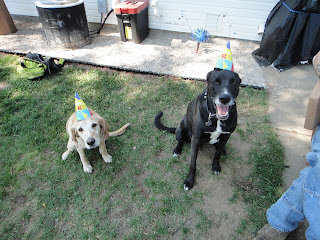
Dog Birthday Party
Who says your dog can't have a birthday party too?
Our dogs were invited to their cousin's birthday party, and we were very excited to go.
There were party hats, games with tennis balls, and even cake made just for dogs.

Our dogs were invited to their cousin's birthday party, and we were very excited to go.
There were party hats, games with tennis balls, and even cake made just for dogs.

Break out the party hats.

Caravaggio and his cousin Jasmine waiting for dog cake.
Subscribe to:
Posts (Atom)